The Cenacolo di Sant’Apollonia is reopening to the public, offering visitors an unusual opportunity to get close to Andrea del Castagno’s monumental Last Supper while restoration work is underway. From November 15, a specially constructed viewing platform will allow onlookers to examine the frescoes at close range, revealing details of their technique, perspective and execution that are difficult to appreciate from the usual viewing position.
Separate from the scaffolding used by the restoration team, the visitor platform has been installed to provide safe, controlled access to the paintings and a closer look at the conservation work. The initiative turns the restoration site into a space for research and public engagement.
The project brings together the Directorate of National Museums of Tuscany, the Opificio delle Pietre Dure, the Archaeology, Fine Arts and Landscape Superintendency for the Metropolitan City of Florence and the Province of Prato, and the National Research Council (CNR). It is supported by the Isabel and Balz Baechi Foundation, a non-profit organization specializing in the conservation and restoration of historic artworks, particularly wall paintings, stuccoes and mosaics. The restoration aims to safeguard the entire painted cycle while improving its legibility. Scientific investigations are also being carried out to examine the materials, painting techniques and conservation interventions undertaken over the centuries.
About Andrea del Castagno’s Last Supper
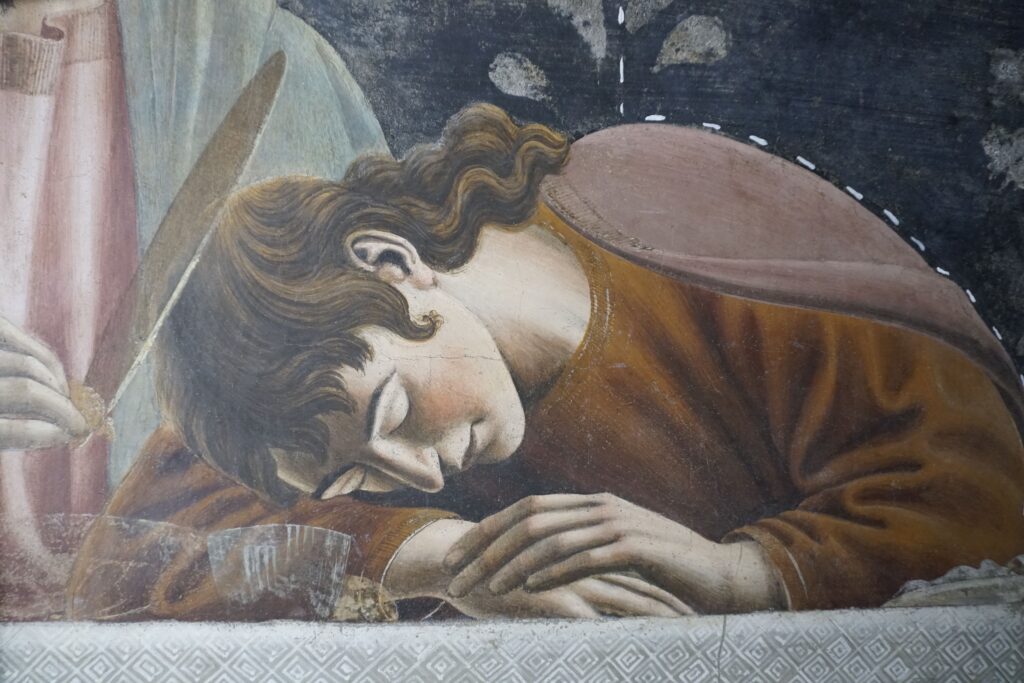
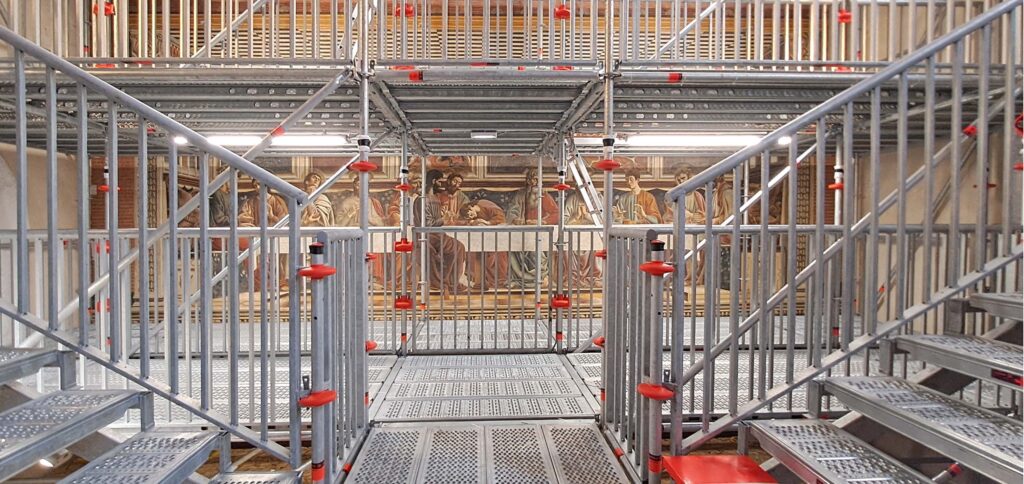
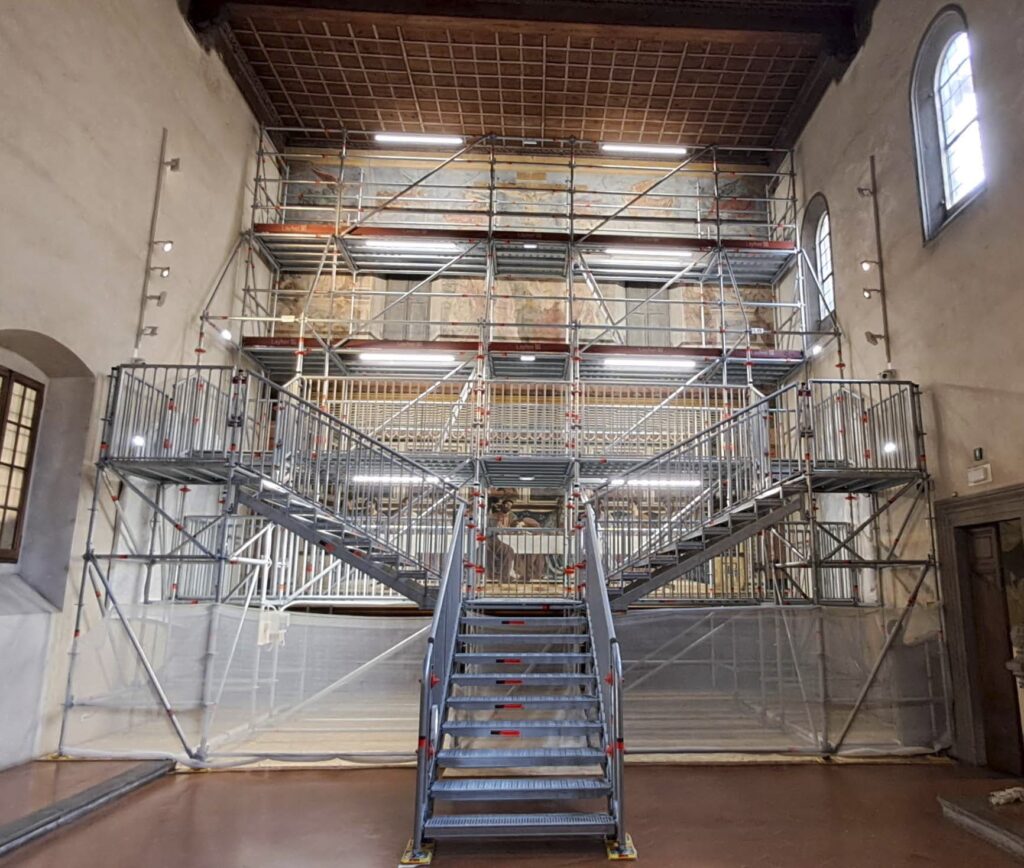
Housed in the former refectory of the Benedictine monastery, founded in 1339, the Cenacolo di Sant’Apollonia is home to one of the most significant examples of early Renaissance painting in Florence. Andrea del Castagno is believed to have completed the fresco cycle between July and December 1447.
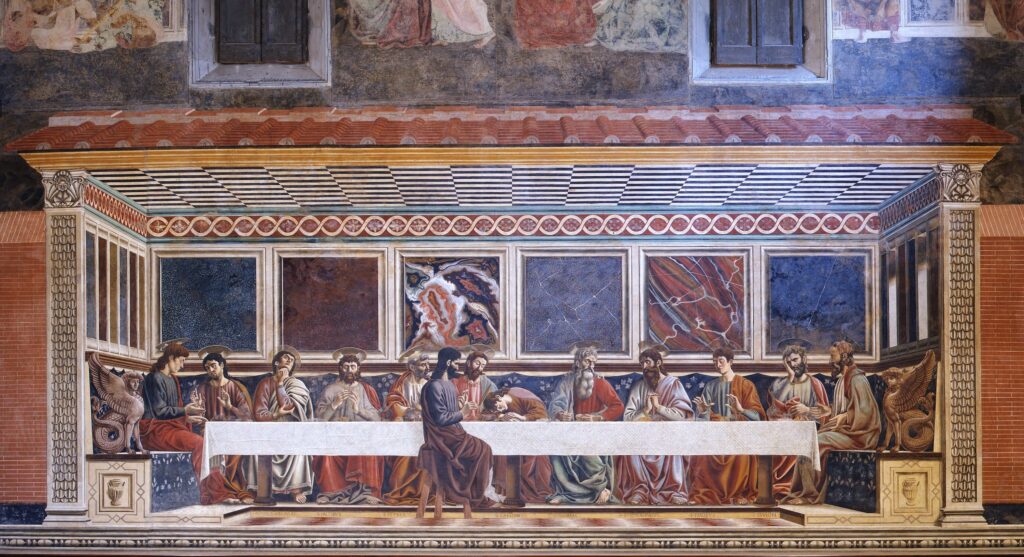
The artist conceived the rear wall as a unified composition depicting the Passion and Resurrection of Christ. The Last Supper occupies the lower section, while three scenes unfold above: the Crucifixion at the centre, flanked by the Resurrection on the left and the Entombment on the right. Connected through a continuous landscape and flying angels, the scenes form a cohesive visual narrative.
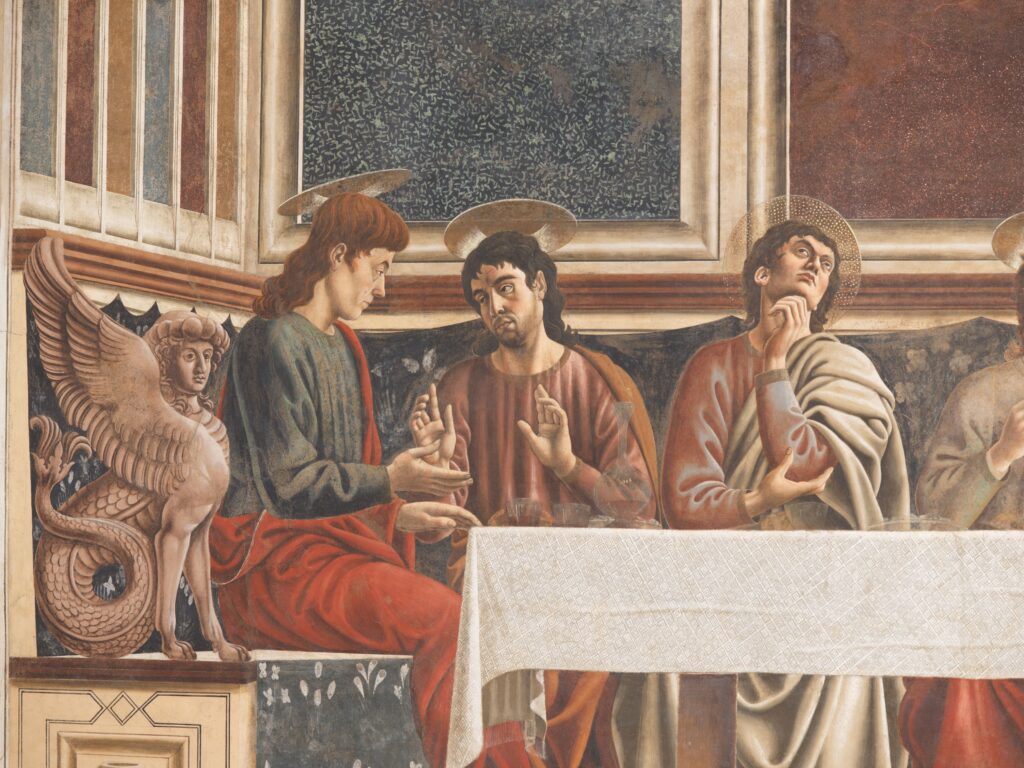
The Last Supper is particularly innovative in its prominence within the overall composition, challenging the traditional hierarchy of refectory decorations in which the Crucifixion typically took centre stage. Christ and the apostles are seated within an elaborate illusionistic loggia, whose painted marble panels, architectural details and carefully constructed perspective create an extraordinary sense of depth. The projecting table, sculptural figures, expressive faces and rich colours demonstrate the technical ambition of Andrea del Castagno’s painting. The cycle’s lighting also contributes to the dramatic effect, moving from the darker, more intense atmosphere of the Last Supper towards the brighter scenes above, culminating in the dawn light of the Resurrection.
For centuries, the frescoes remained largely unknown outside the monastery’s cloistered community. Their restricted access meant that even Giorgio Vasari failed to mention them in his biography of Andrea del Castagno in The Lives of the Artists. Following the monastery’s suppression in the 19th century and the departure of the nuns, the paintings were rediscovered. Their importance led the Royal Galleries to establish a museum dedicated to the artist, which opened on April 1, 1891.
The complex has undergone several conservation interventions since then. While the Last Supper remains in situ on its original wall, the three upper scenes were detached in 1953 for conservation reasons and transferred to secondary supports. The operation revealed the sinopie, the preparatory drawings beneath the frescoes, which were themselves detached in 1961 and are now displayed on the opposite wall of the refectory. These provide valuable insight into the artist’s creative process and the planning of the composition.
Other works associated with Andrea del Castagno are also housed in the refectory, including a lunette depicting Christ in Pity and its preparatory drawing, a Crucifixion from the cloister of Santa Maria degli Angeli, and a preparatory drawing for the Vision of St. Jerome between Saints Paula and Eustochium, originally painted for the Basilica della Santissima Annunziata. A polychrome wooden crucifix attributed to Raffaello da Montelupo, from the church of Sant’Apollonia, stands on the wall adjoining the cloister.
The close-up restoration experience recalls the opportunity offered to visitors in Arezzo during conservation work on Piero della Francesca’s Legend of the True Cross in the Bacci Chapel of the Basilica of San Francesco, when approaching the painted surfaces revealed details normally beyond the reach of the public.
Visiting the Cenacolo di Sant’Apollonia
The Cenacolo di Sant’Apollonia is open Monday to Saturday and on the first and third Sundays of each month, from 8.30am to 1.50pm. Admission is free for visitors under 18 and for everyone on the first Sunday of the month.
Visits from the restoration scaffolding will run from November 15, 2026 to June 26, 2027. Visits last 30 minutes and cost 8 euro per person, with booking recommended. Groups of up to 10 people, including a guide, must book in advance by calling +39 055 354135.
Guided museum and scaffolding visits will also be available from November 21. These take place on Saturdays and the first and third Sundays of the month at 10am and 11.30am. Tickets cost 10 euro, with compulsory booking. Groups are limited to 10 people. Please note that scaffolding visits are only available to visitors aged seven and over. Helmets must be worn, children under 10 must be accompanied by an adult holding their hand, and the experience is not accessible to visitors with mobility difficulties.