
Description
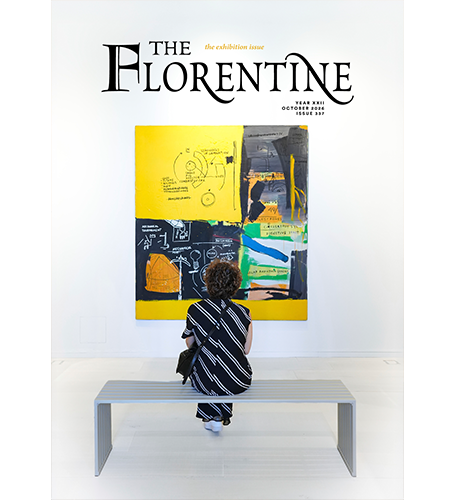
What’s not to love about this time of year? The temperatures are perfect (at last!), the sunsets are mesmerizing and Florence’s art scene is positively popping. Over the past few days, we’ve been overwhelmed—and perhaps suffering from a smidgen of Stendhal syndrome—by the Broken vernissage at Palazzo Strozzi, the Victor Man opening at Museo Novecento, the inauguration of the International Antiques Biennial at Palazzo Corsini and, of course, our cover story on the new home of Collezione Casamonti, where more than 250 modern and contemporary works are now on display.
Taken together, these events are a reminder of the extraordinary cultural quality Florence continues to offer, particularly at a time when overtourism remains a point of contention, social media can flatten experiences and AI risks encouraging laziness on the creative front. I’m guiltier than most of being glued to my mobile phone—recording videos, taking photos, communicating—but October in Florence feels like an enticing invitation to join the offline club.
The new Strozzi exhibition, Broken. The Power of a Fragment, is a masterclass in curation by the National Gallery of Art in Washington, purposely resisting the logic of social media spectacle. The dimly lit rooms and carefully composed shadows are not exactly designed for the average content creator’s lens. (Granted, one hall does provide plenty of visual drama.) The exhibition asks us to slow down, look, feel and learn rather than attempt to capture.
At Collezione Casamonti, meanwhile, sensory overload is almost guaranteed. Now gathered under one roof at the sumptuously restored Palazzo San Giorgio on lungarno Serristori, after being presented in two separate rotations at its former home in piazza Santa Trinita, the collection is a riot of colour, movement and depth. One minute you’re immersed in a Macchiaioli scene of rural Tuscany; turn around and you’re challenged by the whimsy of Chagall, the drama of Fontana or the unsettling video performance art of Abramović.
Further proof of Florence’s global cultural prestige can be found at the International Antiques Biennial, or BIAF, as it is affectionately known, which runs through October 4. Founded in 1959, the Italian art fair is now in its 34th edition, more than six decades after the Bellini family first brought leading antiquarians together at Palazzo Strozzi, before the event moved to Palazzo Corsini in 1997. The quality of the exhibits is, naturally, the main draw. There’s a marble sculpture commissioned by Marie de’ Medici for the Luxembourg Gardens in Paris, an Andrea della Robbia glazed terracotta Christ Child, works by Giorgio de Chirico and plenty more besides. What blew my mind, however, was the opportunity to wander through the 17th-century Palazzo Corsini, particularly the rarely opened piano nobile and Baroque throne room. Inspired by the noble palaces of Rome, the story goes that, at first, Florentines being Florentines were nonplussed by its grandeur (“too different”, “too ostentatious”). Today, it’s a lovemark among locals as one of the most sought-after visits and venues in the centro storico.


