Florence is preparing to welcome back some of the greatest treasures of the Renaissance in an ambitious exhibition dedicated to one of the city’s most celebrated historical figures. Magnifico 1492, organized by the Uffizi Galleries, will open at the Treasury of the Grand Dukes at Palazzo Pitti from December 3, 2026 to March 1, 2027, bringing together more than 100 works associated with Lorenzo de’ Medici, known throughout history as Lorenzo the Magnificent.
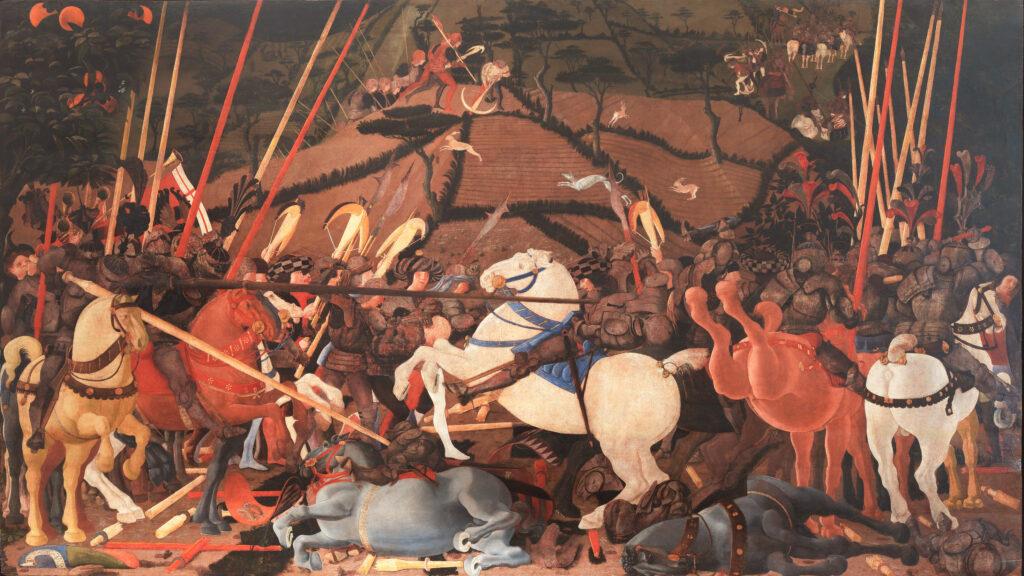
A historic reunion is at the forefront of the exhibition. The three panels of Paolo Uccello’s Battle of San Romano will be displayed together for the first time. Divided between the Uffizi in Florence, the National Gallery in London and the Louvre in Paris, the paintings will return temporarily to the context for which they were originally intended: the Medici family residence in Florence.
The exhibition promises to be much more than a showcase of Renaissance masterpieces. Drawing on extensive new scholarly and curatorial research, it will reconstruct the collection assembled by the Medici family and housed in Palazzo Medici Riccardi. The starting point is the inventory drawn up in 1492, the year of Lorenzo’s death, which provides an unusually detailed record of the family’s possessions and offers insight into the artistic, intellectual and cultural ambitions of the dynasty.
Visitors will be invited to explore the individual works as well as their original arrangement within the rooms of the Medici residence, gaining a better understanding of how art collecting reflected the family’s political aspirations, philosophical interests and vision of power.
Alongside paintings and sculptures, the exhibition will bring together a variety of objects, including precious vases, gems, cameos, coins, manuscripts and maps. Loans from major Italian and international institutions will help recreate the breadth of a collection that reflected the Medici’s seemingly limitless curiosity and appetite for beauty, knowledge and prestige.
Among the highlights is a gilded bronze Spiritello (Sprite), created by a sculptor close to Donatello. Originally placed on the fountain in the courtyard of Lorenzo’s residence at Palazzo Medici, the sculpture will travel to Florence from New York’s Metropolitan Museum of Art. Another exceptional loan comes from the Bibliothèque nationale de France in Paris: an illuminated manuscript of Francesco Petrarch’s Triumphs, personally commissioned by Lorenzo. Copied, decorated and bound for his private use, the precious volume was among the treasures he kept in his study.
For Simone Verde, director of the Uffizi Galleries, the exhibition provides an opportunity to reconsider the collecting practices of the early Medici through previously unpublished research. The aim, he explains, is to understand the significance of their artistic choices within the wider political strategy of a family determined to consolidate and extend its influence across Italy and beyond.
Lorenzo di Piero de’ Medici (1449–92) remains perhaps the most recognizable figure of the dynasty that would govern Florence and Tuscany for centuries. An accomplished statesman and astute political operator, he was also a passionate patron of the arts and a central figure in the cultural flowering of the Renaissance. His circle included some of the greatest minds of the age, including Angelo Poliziano, Marsilio Ficino and Giovanni Pico della Mirandola as well as artists such as Botticelli and the young Michelangelo. Under his patronage, Florence strengthened its position as one of Europe’s great centres of artistic and intellectual life.
The title Magnifico 1492 evokes both the extraordinary figure of Lorenzo and the pivotal year in which his life came to an end, leaving behind a collection that offers a portrait of Renaissance Florence at its apex.
The exhibition will be open Tuesday to Sunday, from 8.15am to 6.30pm, with last admission at 5.30pm.