When he died in 1455, Fra Giovanni da Fiesole was the most influential Florentine painter of his time. Posterity has renamed him Fra Angelico. Known by paintings that he made in Fiesole, Florence and, in the last decade of his life, in Rome, his work supplied a need in times of church reform for clear and spiritually stimulating religious imagery. Almost 600 years later, his appeal is universal, nurtured by endless reproduction of his masterpieces. Angelico did not so much achieve a style of quintessential purity as express his intense personal devotion. He painted his faith.

An outstanding museum show about an artist whose greatest works are frescoes still in their original locations is no ordinary feat. The great advantage for this memorable display is that it extends over two venues. One is San Marco, the monastery that Angelico embellished with images that are among the most memorable pieces of religious art. Gathered at Palazzo Strozzi, the second venue, are loans by institutions across Italy, Europe and the United States. Dispersed over centuries (and especially during the Napoleonic era) into diverse collections from the Italian religious buildings they were made for, panel paintings, drawings and illuminations by Angelico and his contemporaries, including sculptors, have been brought together with works that have made the short trip across Florence.
The visual effect is astonishing. Crucifixions abound and the Virgin is enthroned on numerous occasions around the galleries. The Christ Child sits or stands on her lap as saints collect around them. There is a lot of gold, and the effect is thrilling. There is bold colour, too. Angelico’s early prominence came from illuminating missals with detailed miniature images. The techniques stayed with him and made possible a workshop of assistants. As years passed, harmonies of colour become more luminous and sophisticated, reaching a zenith in the magnificent and dramatic fresco, Madonna of the Shadows (1439-45), in the upper-level cells of San Marco. Also watch the transition underway from the highly decorated medieval conventions of International Gothic, with its pointed arches, elegant poses and delicate naturalistic detail, as Angelico mastered the “new style”, intellectual and restrained, which grew up among humanists inspired by classical culture, its literature, philosophy and architectural principles.
His output, bolstered by workshop production, was considerable. The show’s selection makes comparisons possible across Angelico’s working life. They reveal an artist who was more progressive and cerebral than his popular reputation for prettiness suggests. His methods fused Gothic tradition with the revolutionary pictorial innovations of his contemporary Masaccio, at work in Santa Maria del Carmine where Angelico professed in 1417. Equally influential was the sober, geometrical architecture of Brunelleschi and Michelozzo as well as the sculpture of Ghiberti, who was leading the Renaissance reinterpretation of antiquity.

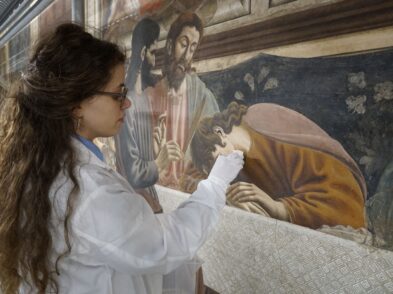
Look how the figures in Angelico’s newly restored Deposition (mid 1430s) are graceful and elegant, with jewel-toned drapery and fine chins. That’s Gothic, as are the flat, stagey mountains behind. The linear perspective is tentative at best. But the faces interact in a Renaissance way and form is becoming modelled with shadow.
The reconstruction of the San Marco Altarpiece (1438-42) is a spectacular highpoint. Dismantled in the seventeenth century, many panels now reside in Washington, Munich, Dublin and Paris. The large, main section, however, plus two predella panels and two small side panels from the flanking pilasters depicting Dominican saints, belong to San Marco. These disparate elements have been reunited at Palazzo Strozzi, confirming the work’s richness and great significance.
The commission came from Cosimo de’ Medici, San Marco’s benefactor. He preferred the new Renaissance style to the outmoded Gothic. On his return to Florence from exile he engaged Michelozzo to rebuild the monastery on stark, serene classical lines. Supplanting the resident order, Cosimo moved in Dominicans from Fiesole, whose strict observance of their rule he admired. The friars’ lifetime of meditation, therefore, took place in the midst of the language of modern visual culture. The altarpiece was intended to remind the friars of Cosimo’s munificence. Moreover, on feast days, the altar was visible to the wider population and usefully promoted Medici civic values. Angelico was content to promote his patron.
The central panel, sadly dulled in colour and detail by past overcleaning, once again presents Mary and her Son. However, Christ becomes a human, naked baby rather than a miniature adult and the dome-headed saints around the throne are unified into a loose gathering, an arrangement known as a sacra conversazione, a motif the artist pioneered. They seem weightily present. The two saints in the foreground are the martyred physicians Cosmas and Damian. Venerated by the Medici family, who dominated the church’s Feste de’ Magi fraternity, each is shown equipped with the family’s red cap. Damian looks out of the picture at the faithful as if ready to intercede with Jesus and his Mother. Beneath the brothers, Angelico has devised a Turkish carpet with a pattern incorporating the Medici emblem, the palle. Painted with breathtaking precision, it underlines the subtle illusionistic perspective of the picture. Above all, crystallised in the format and background are many of his experiments with panel painting. Unlike his earlier altarpieces, San Marco’s was executed on a rectangular panel without any decorative arches. The painted architecture is classical, also free of Gothic influence, and fronts a verdant landscape with its screen of trees. The smaller predella panels show an advance, too, in how weight, light and space are treated. In The Miracle of the Black Leg, the two Medici surgeon saints heal a church deacon’s leg ulcer with a swift, night-time transplant from an Ethiopian donor.


Angelico’s purpose was not the production of great artworks for gallery visitors, but pious imagery designed to exalt his Saviour. Regardless of format, his paintings presented a pathway for prayer. Consequently, details of nature and human behaviour act as channels for psychological and spiritual dialogue. His frescoes are less conservative in style than his panel paintings, in which conventions of the Dominican order held sway. He modified many of those traditions, but maintained a balance. Keen to represent the Church in the ongoing humanist discussions, he chose to preserve the “sacred” conventions in art.
At San Marco, those conventions dictate the appearance of his largest fresco. The Crucifixion (1439-45) in the chapter house where meetings were held maintains the law on iconography expected by a strict community of preachers. No depth appears in the arrangement of figures and the setting is severe and sombre. Yet in the individual cells upstairs, his approach eased and clarified. In these intensely private and devotional images, Angelico sought to combine the familiar with the transcendent. God could be recognised within the bounds of human experience, in the architecture, scenery and costume of contemporary Florence. Thus, each cell seems to have two openings: one through a window to the physical world and another giving onto the spiritual dimension.
Of course, the greatest is the Annunciation (c. 1443). Greeting visitors as they climb the stairs to the barn-like dormitory are simply conceived figures in an open loggia not unlike the monks’ own cloister. Focused pictorial light models columns with shadow, while muted natural light gently reflects off the mineral mica that Angelico seems to have mixed into the pigment of Gabriel’s wings. Perhaps the visitor senses that the stairway could reach into this scene. It takes place just beyond the cell’s wall suspended in an imaginary space that is timeless and essential. Angelico achieved the sublimation of artistic technique to an austerely spiritual encounter.
Fra Angelico
Palazzo Strozzi + Museo di San Marco
Until January 25, 2026