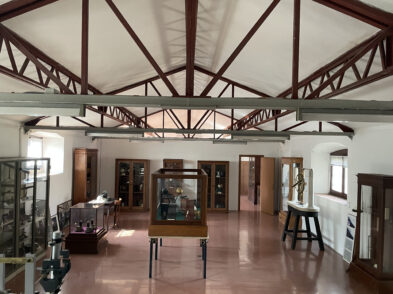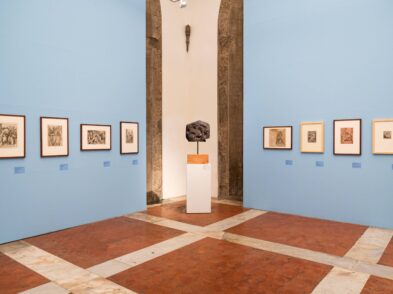
On October 11 and 12, Italy’s Environment Fund, known as FAI, invites the public to visit places that are usually closed or little known. For the occasion, three relatively unknown gems are open for the weekend in the Florence area: the RAI Florence television broadcasting headquarters, Palazzo Pazzi Quaratesi and Badia Fiesolana, home to the European University Institute.
All three places are open 10am-5pm on Saturday, October 11 and Sunday, October 12.
In the television studios: RAI Florence regional headquarters

Built in the mid-1960s by the rationalist architect Italo Gamberini, who was also responsible for the interior furnishings and the garden, the RAI headquarters (largo Alcide De Gasperi 1), in the Varlungo area of Florence, remains an important example of new technologies applied to specialized public buildings, particularly in the radio and television sector. It earned Gamberini the ING/ARCH award in 1969. The building stands out for its clear variations in heights and volumes. The complex is organized around a main office block, which is connected to a second wing. The functional diversity is highlighted not only by the volumes, but also by the different window designs: ribbon windows for the offices and smaller, more compact ones for the production areas. Reinforced concrete is predominant, except in the main atrium and the upper floors, where the use of a metal framework allowed for the installation of larger windows and increased light On the exterior, orange silipol cladding evokes traditional Florentine colours of terracotta and pietraforte. The towers, in sharp contrast, are finished with porcelainized steel and ribbed copper, standing out against the orange background.
The headquarters is being opened to the public for the first time on this occasion, offering visitors a unique opportunity to access the technical studios that have given voice and faces to national broadcasting in Tuscan for over 50 years. Explore the operational spaces where regional news programs are produced daily and walk through the places that have hosted iconic shows, like the popular Corrida. Check out the vintage radios and old scripts that show how broadcasting has evolved down the ages.
A place of conspiracy: Palazzo Pazzi Quaratesi

The “Palace of the Conspiracy” (via del Proconsolo 10), as it’s otherwise known, stands imposingly on the corner of via del Proconsolo and borgo degli Albizi, representing one of the finest and most complete examples of civil architecture from the High Florentine Renaissance. Its grandeur was commissioned by Jacopo de’ Pazzi as an open display of power and wealth, in direct competition with the Medici family. The façade, often attributed to Giuliano da Maiano, offers an elegant study in contrasts: the ground floor is built with austere rusticated stonework, while the upper floors lighten the appearance with smooth masonry and the use of pietra serena to frame the magnificent bifora windows, adorned with family emblems. The historic nickname reflects the building’s pivotal role in the political drama of 1478. The plot was born from the fierce political and economic rivalry between the banking dynasty of the Pazzi and the rising dominance of the Medici, particularly Lorenzo the Magnificent. With the support of Pope Sixtus IV, within these walls the Pazzi plotted a conspiracy to eliminate the two Medici brothers and overthrow Medici rule in Florence, a plan that failed in its main objective, but resulted in the death of Giuliano de’ Medici and led to the bloody downfall of the Pazzi family.
Today, the palace houses the Regional INPS social security offices, but it still preserves the memory of one of the most pivotal and violent events of Renaissance Florence.
A European education: Badia Fiesolana

Located in a panoramic position overlooking Florence, the Badia (via dei Roccettini, Fiesole) boasts a millennia-old history that dates back to the Early Middle Ages, when it served as Fiesole Cathedral until 1028. Its troubled past includes both periods of grandeur, as the seat of a bishop, and disgrace, notably its destruction in the 12th century by Florentines, who had sacked Fiesole. It was later rebuilt by Camaldolese monks and passed through the hands of various congregations, but its greatest period of splendour began in 1456, thanks to the patronage of Cosimo the Elder de’ Medici. Under the direction of renowned architects such as Brunelleschi and Michelozzo, the complex was expanded and decorated, taking on its current Renaissance appearance inspired by models like San Lorenzo. The goal was to turn the Badia into a centre of culture, equipping it with a refectory, dormitory and library to welcome scholars and intellectuals. The church preserves an element of extraordinary beauty and uniqueness: the Romanesque façade from the 12th century. It features a magnificent polychrome inlay of white and green marble, recalling Florentine Romanesque style (such as the Baptistery and San Miniato al Monte), standing out against a bare stone structure that appears unfinished. After its Renaissance revival, the Badia entered another period of decline around 1520, when it was converted into a quarantine hospice for syphilis patients, and later, in 1530, served as a military camp for the troops of Charles V.
After centuries of various uses, in 1976 the vast complex was designated as the main headquarters of the European University Institute (EUI).
The full list of places open by FAI this weekend can be found here.