For centuries, Giotto’s Saint Francis has watched over the Bardi Chapel at the Basilica of Santa Croce through layers of limewash, changing ideas about restoration and the passage of time. Now, after four years of intensive study and conservation, the frescoes return to view on September 12, offering visitors a renewed encounter with a masterpiece of Florentine art.
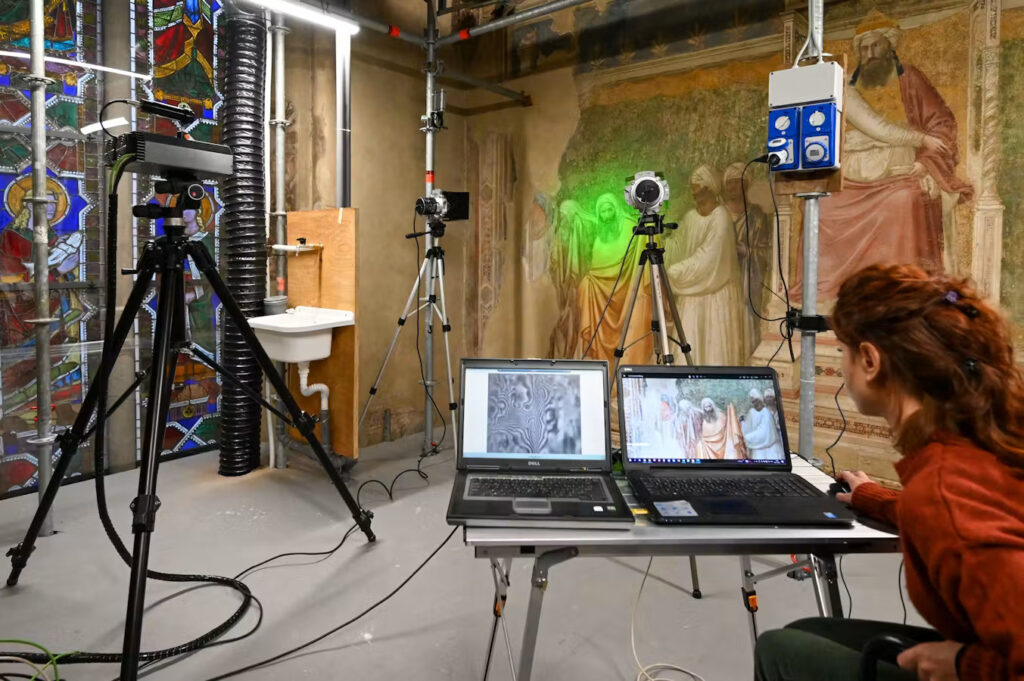
Led by the Opificio delle Pietre Dure and promoted by the Opera di Santa Croce, the campaign combined scientific investigation, conservation and digital mapping to reveal the artist’s extraordinary invention of painted space with unprecedented clarity.
The Bardi Chapel is one of Santa Croce’s most important artistic treasures. Probably commissioned by the powerful Florentine banker Ridolfo de’ Bardi, the decoration dates to after 1317 and probably before 1325. On its walls, six principal scenes recount episodes from the life of Saint Francis, based on Bonaventure da Bagnoregio’s Legenda maior. Above the entrance arch, the Stigmatization completes the narrative, while saints and Franciscan virtues occupy the remaining spaces. The cycle tells the story of Francis as an alter Christus: from his renunciation of his father’s wealth and the approval of the Rule to the apparition at Arles, the trial by fire before the Sultan, his death and the posthumous apparition to Brother Augustine and Bishop Guido. But it is the way Giotto constructs these stories that makes the chapel so extraordinary.
A new way of seeing space
Giotto did not simply place his figures against painted backgrounds. He created a world that appears to continue the chapel’s actual architecture. Buildings, columns and architectural structures frame the narratives like enormous boxes opening towards the viewer. Even apparently outdoor scenes are carefully orchestrated through perspective and the positioning of figures.
The effect is particularly striking when the chapel is viewed from its centre. Giotto understood how the paintings would be seen from below and adjusted his compositions accordingly, manipulating proportions and foreshortening to create a convincing sense of depth. The relationship between figure and setting is also different from his earlier work, while facial expressions and gestures bring an unprecedented psychological intensity to the stories. The restoration has brought this spatial invention back into focus. The architectural framework was constructed directly on the wall with exemplary precision. Conservators identified incisions made in the plaster and lines produced by snapping pigment-soaked cords against the surface, traces of the painstaking process through which Giotto and his workshop established their painted architecture. For the first time, these elements have been digitally mapped in their entirety, allowing the spatial design to be understood as one interconnected system. The result is a clearer reading of Giotto’s pictorial revolution.
Giotto and his workshop


The restoration has also revealed more clearly the differences between the hands and techniques involved in the cycle.
By this stage of his career, Giotto was working with a team of painters and the Bardi Chapel provides an important glimpse into this collaborative process. Technical and stylistic variations have become more apparent through the conservation work, reinforcing the chapel’s role as a laboratory for ideas that would influence Florentine painting in the decades that followed.
The campaign also demonstrated Giotto’s willingness to adapt his materials to his artistic needs. While the paintings began using the fresco technique, extensive a secco work applied after the plaster had dried, allowed the artists to use a wider range of pigments and achieve different chromatic and spatial effects. It also gave them greater flexibility over the pace of execution.
A masterpiece with a complicated past

The beauty that can now be seen is inseparable from the complicated history of the chapel itself. At some point before 1730, the frescoes were covered with layers of limewash, meaning that they remained hidden until 1851, when sections of the 14th-century paintings emerged during preparations for new decoration. Their recovery was entrusted to Gaetano Bianchi. The mechanical removal of the limewash, known as descialbo, brought Giotto’s paintings back into view, but also caused extensive abrasions, scratches and losses.
The chapel suffered further changes in the 19th century, when the cenotaphs of architects Giuseppe Salvetti and Niccolò Gaspero Paoletti were installed in the lower sections of the side walls. Their subsequent removal resulted in the permanent loss of the frescoes behind them. Bianchi reconstructed many missing sections and unified the surfaces with extensive tempera retouching. For almost a century, visitors were therefore seeing Giotto through the filter of 19th-century restoration.
A very different mindset emerged in the late 1950s, when superintendent Ugo Procacci and restorer Leonetto Tintori undertook another major intervention. Between 1957 and 1959, Bianchi’s overpainting was removed in an effort to recover the surviving original. Tintori intervened minimally, leaving the numerous losses in the plaster visible rather than reconstructing them. That approach was pioneering in its respect for authenticity, but it also left the cycle visibly fragmented.
More than 60 years later, the latest campaign has attempted to find a new balance: preserving the evidence of the past while restoring enough visual continuity for Giotto’s compositions to be understood once again.
The details that had disappeared

Over four years, conservators addressed problems that were largely invisible to visitors but posed serious risks to the paintings themselves. Cracks in the walls, areas of detached plaster, lifting paint and widespread soluble salts were treated. Deposits and altered materials were removed, while incompatible synthetic fills from earlier interventions were replaced with materials more closely suited to the original plaster.
Treating the losses was perhaps the most delicate task. Around 5,000 gaps, ranging from substantial missing sections to tiny lacunae scattered across the surface, as well as widespread abrasions interrupted the visual rhythm of the paintings. Rather than attempting to erase the damage, conservators used different methods of integration according to each situation, restoring continuity where possible while keeping the interventions recognizable.
The vault has emerged as one of the most intriguing discoveries. Having received less attention during previous campaigns, it has been cleaned with the additional use of laser technology, bringing renewed clarity to the Franciscan allegories, particularly Obedience and Chastity.
A restoration made possible by many
The project was made possible through a partnership between Opera di Santa Croce and the Opificio delle Pietre Dure, with support from the Ministry of Culture, Fondazione CR Firenze and ARPAI, alongside private donors including Veronica and Dominique Marzotto Desforges, Jon and Barbara Landau, William von Mueffling and Anne Farrell.
The international #Giving4Giotto campaign extended that circle of support, reflecting the sense that the frescoes belong not only to Santa Croce or Florence, but to a shared cultural heritage.
Florentines were also given an unusually close relationship with the restoration through Fondazione CR Firenze’s A tu per tu con Giotto project. More than 2,500 people were able to climb the restoration scaffolding and observe the frescoes at close quarters, witnessing details and techniques normally hidden from view.
The research carried out during the campaign will continue to inform the study and conservation of the cycle. The vast body of scientific data that has been gathered will provide a foundation for future research, while the detailed understanding of the materials will allow specialists to monitor the paintings and respond more precisely to any deterioration.
The scaffolding may now be coming down, but the work of understanding Giotto is far from over. When the Bardi Chapel opens again, visitors will see familiar stories: Francis renouncing his worldly possessions, facing the Sultan, dying surrounded by his friars. Yet they may also see something that has been harder to perceive for generations: the astonishing architecture of Giotto’s imagination, where painted and real space meet and where a Florentine chapel becomes a place for a new way of seeing.