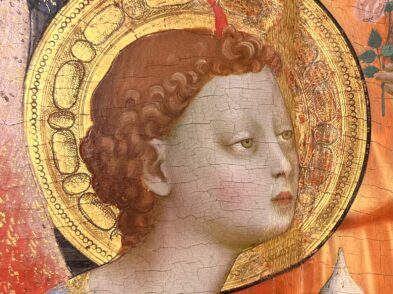
Eyes lifted and neck back, I’m searching for Lucrezia among the frescoed faces of the Tornabuoni Chapel in Santa Maria Novella. Some are crowned with golden halos like tilted dishes, one holds on her head instead a real dish piled with fruit. The fresco before me is full of women. Men appear only in the background, looking over a wall at the town or chatting in an archway, unaware of the moment unfolding in the foreground. It is Mary and Elizabeth, both pregnant, reaching, almost clutching each other’s arms. Their faces are somber as if weighed down by their pregnancies, one with Christ, one with John the Baptist. On either side of them, groups of women look on, maidservants or attendants to the Visitation, many with female faces from the Tornabuoni family.

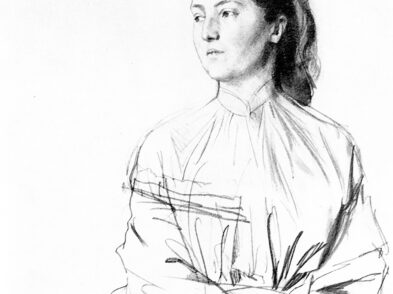
Lucrezia might be the one on the far right, the only figure in darker matronly colors, a white scarf covering her hair, hands clasped and eyes lowered, with a slight smile on her face, as if she’s remembering something. Her life, perhaps. Attributions to Lucrezia are taken from the similarity of this portrait to a known Ghirlandaio portrait of her, but it might also be her sister, Dianora. The fresco was completed by Ghirlandaio in 1491, nearly a decade after Lucrezia’s death, and there is no exact certainty as to the identities of the women. If this is Lucrezia, it is a portrait of one of the most powerful and influential people in 15th-century Florence. Politician, ambassador, business owner and poet.
Lucrezia Tornabuoni was born in 1427 to a noble Florentine family that dated its lineage to the tenth century. At age 16, she married Piero de’ Medici (known as “the Gouty”), with whom she had eight children, including Lorenzo (“the Magnificent”). Two of her grandsons would become pope and usher in the Medici takeover of the Florentine Republic in the 16th century. While the stories and names of these men are well known, Lucrezia’s life is rarely included in the typical Medici timeline as more than a side note, and yet she was essential to the success and reputations of all of them.
Legend has it that her father-in-law, none other than Cosimo il Vecchio himself, called her “the only man in the family”. She learned a lot from him, which came in handy when Piero was ill in bed with gout. She managed the Medici affairs and negotiated the marriage of her son to Roman nobility, thus paving the way for the entry of two grandsons into the Papal Curia and later the papacy. When it came to the education of her sons, she procured tutors like Angelo Poliziano, whose career she supported as a patron. (Someone who would become part of the group of lauded scholars at Palazzo Medici under Lorenzo.) She was the one who taught her children Latin. Her influence on Lorenzo was the driving force towards his humanist patronage and scholarship. When Piero died in 1469, she became the head of Medici affairs at 42 years old, running the bank, especially when it was clear Lorenzo was not so inclined. She also made a series of investments around Viterbo to revive thermal spas properties, managing rental incomes, commercial profits and long-term land appreciation. She was not only a political matriarch, but also a poet.
Lucrezia composed a series of religious works called laudi, or devotional hymns, as well as storie sacre. In these retellings of Bible stories, she frequently focused on biblical women like Susanna, Esther and Judith. She wrote in the vernacular, something that her son Lorenzo would continue to popularize. Her retelling of the Judith story is an example of an early “feminist” take on a classic, though the concept of feminism as we know it today would not have been an intention in her time. The tale (from the Apocrypha) is of a widow who saves her people by infiltrating the camp of the general Holofernes. Dressing attractively, she enters the camp and after a feast, while Holofernes is drunk, she and her maidservant behead him, thereby saving her people. It’s kind of the female David and the Goliath story.

In Lucrezia’s version, Judith is a thinking and acting character, not a passive occupier of a symbolic role. She delivers long speeches, her reasoning clearly articulated. Her piety and purity are emphasized, and her political motives are clear. She describes Judith as having a “manly heart” and she speaks to Holofernes with the “tu” form, placing him on equal standing with her: the widow versus the general. Then “she struck him twice with force and his head rolled away from his shoulders” before she hands the head to her maid with a simple remark, “Say nothing”.
Lucrezia’s writings were bound in an illuminated manuscript shortly after her death in 1482. Poliziano praised them and used them in his teachings. A line of her poetry featured in a Florentine play about Judith in 1518, showing how her writing had entered the public cultural consciousness.
The Basilica of Santa Maria Novella holds the stories of many Florentine women. There’s the tomb of Villana de’ Botti, the “veiled woman”; the Last Supper by Plautilla Nelli; the Spanish Chapel and its connections to Eleanor of Toledo; and the frescoes in that same chapel of Beatrice, Fiammetta and Laura, the beloved of Dante, Boccaccio and Petrarch. So, why am I standing in front of the one woman I can’t properly identify? One who has also been attributed to other faces in the chapel? So many women’s lives and achievements have been lost to history, but because of Lucrezia’s high position, we have a remarkable amount of information about her. We know her story and her writing. The face on this wall might not be hers, but I prefer to imagine that it is, the one bearing the slight crook of a satisfied smile.