Throughout the centuries, some individuals have been fortunate—or at times unfortunate enough—to witness history in the making and have felt compelled to write about what they saw. One such favoured person was the Countess Walburga Ehrengarde Helena von Hohenthal, Lady Paget.
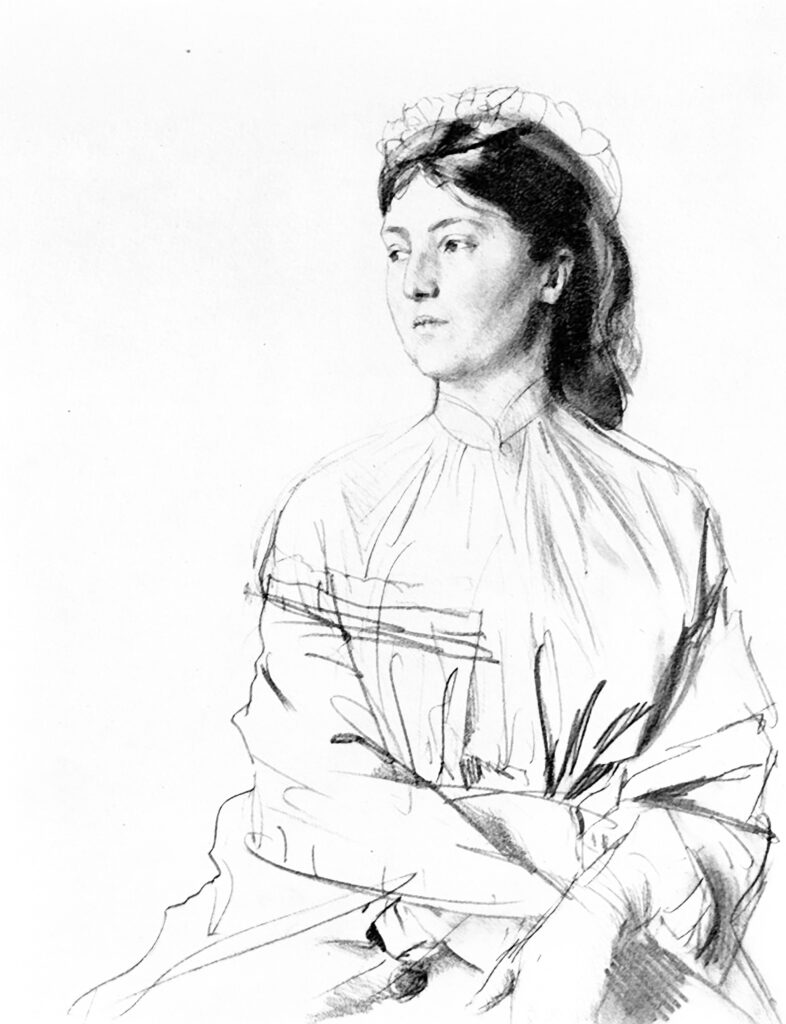
An aristocrat, socialite and writer, she was the wife of Sir Augustus Berkeley Paget (1823–96), whom she had married in Denmark in 1860. A well connected and respected British diplomat, he later became a member of the Privy Council. He joined the diplomatic service and obtained his first appointment as temporary attaché in Madrid in 1843, followed by postings as a précis writer to the foreign secretary, Lord Aberdeen, then the British Embassy in Paris and, next, a promotion to the legation in Athens in 1852. Later that year, he was sent to Egypt as acting consul general before serving as secretary of legation in The Hague in 1854. By 1857, he was chargé d’affaires in Lisbon. Subsequently, he worked as envoy extraordinary and minister plenipotentiary to the King of Saxony in Berlin before being assigned to Denmark in 1859 and then returning to take up another posting in Portugal.
The Pagets’ 14-year Italian adventure began in 1867, when Augustus was made envoy extraordinary and minister plenipotentiary to King Victor Emmanuel as the country was in the critical throes of unification. The couple and their three children, two boys and a girl, settled in Florence, which had become the kingdom’s new capital. In her book, Scenes and Memories, published in 1912, Lady Paget tells us that “the King had the qualities of a great sovereign and founder of a thrown [sic]. His indomitable courage carried him through all his difficulties, but both he and Cavour forgot that they were not immortal and that they had built up an edifice which would require strong shoulders to carry it.” She added in the same publication that the family’s arrival in the city, which had only been “the capital for a year or two, and there was about the exquisite city ‘pulita quanto un gioello’ [clean as a jewel, ed.] as Benvenuto Cellini terms it, that subtle but saddening charm pertaining to all beautiful things which one knows doomed to be adapted to modern exigencies”. She ended her judgment of the town by commenting with her often expressed waspish distain that “noble old walls were beginning to fall to allow more extended traffic” and that “old palaces and convents walls were beginning to be converted into barracks and Government Offices, and in several places the alien want of taste imported by its northern masters had begun to show itself in Tuscany.”
The daughter of Count Karl Friedrich Anton von Hohenthal and his wife, Countess Emilie Neidhart von Gneisenau, Lady Paget was born in Berlin on May 3, 1839. As a young girl, she was a lady-in-waiting to Queen Victoria’s daughter, Victoria, Crown Princess of Prussia (1840–1901), who later became the German Empress and Queen of Prussia. When Rome became Italy’s capital in 1870, she chose Villa Torlonia as the site for the British Embassy, which several decades later became the home of Benito Mussolini and his family. Their next posting was to the Imperial Court in Vienna in 1884, from which her husband retired in 1893. In the meantime, Lady Paget had rented Villa Caprini in Fiesole in 1887 and, after her husband’s retirement, she purchased the Torre di Bellosguardo, extensively renovating it and landscaping the gardens. After her husband’s death, it became her main residence, where she spent much of her time campaigning with other expats like Vernon Lee, in efforts to save parts of medieval Florence from demolition and redevelopment, such as the Jewish ghetto. A major figure on the cultural and social scene, she was visited by Queen Victoria in 1893, while she was holidaying in Florence. Given that she did not like keeping late hours, she lamented that “mothers and daughters used to arrive at my balls at two and three o’clock A.M., and always wanted to dance till six in the morning, when it was the fashion to drive straight to the Cascine and breakfast there.”
With World War I looming and after selling the tower, she returned to England in 1913. A prolific author and memorialist, Lady Paget was also a passionate vegetarian and dabbled in the occult. Later, with the advent of Fascism, she became a supporter of Mussolini in 1924, believing he would save Italy from Bolshevism and anarchy, but she never lived to see the catastrophe he wrought on her adopted country. She died of burns on October 11, 1929, at the age of 90, after she fell asleep reading the paper by the fire at Unlawater House, Newnham on Severn in Gloucestershire where she was living at the time. She was buried in the Tardebigge cemetery in Worcestershire alongside her husband, who had died of a cerebral haemorrhage aged 73 in 1896.