Did you know that Vallombrosa was a cultural mecca for the British literati? Inspired by John Milton, a stream of literature lovers visited the shadowy forest. The area went on to become the first ever Italian holiday resort with its own railway system that brought holidaymakers up the mountainside.

Vallombrosa is situated approximately 30 kilometres to the east of Florence and 1,000 metres above sea level. It has been a place of spiritual importance since the Middle Ages and in the 1500s a large abbey surrounded by forests, brooks and natural waterfalls was constructed for the religious education of young men. In 1575, one of these young scholars was Galileo Galilei, who spent three years studying there. When Galileo was an old man, living under house arrest in Florence, he received a visit from the young poet John Milton, who went on to write Paradise Lost in 1667.
“…Stood and call’d
His Legions, Angel Forms, who lay intrans’t
Thick as Autumnal Leaves that strow the Brooks
in Vallombrosa, where th’Etrurian shades
High overarch’t imbowr….”
–Paradise Lost, Book 1
It is uncertain whether Milton really visited Vallombrosa in person or whether he was inspired by Galileo’s descriptions of the strange and striking beauty of the forest. The facts relating to his sojourn became almost irrelevant and through his evocative verse Vallombrosa became part of the cultural tour of Italy from as early as the end of the 17th century. The wave of visitors peaked in the mid 1800s, a plaque to Milton was erected, and Vallombrosa was mentioned in famous guidebooks such as Baedeker and Murray.
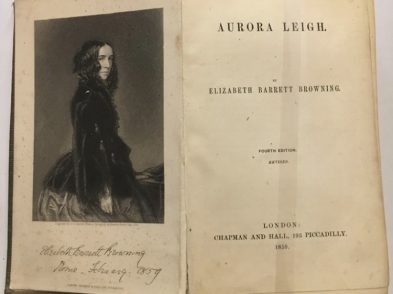
Among the travellers who partook in this intellectual pilgrimage during Victorian times were William Wordsworth, who penned At Vallombrosa, Mary Shelley is known to have visited as did Edith Wharton, John Ruskin and Henry James, as well as Robert and Elizabeth Barrett Browning, who wrote about Vallombrosa in Casa Guidi Windows: A Poem. These writers were accommodated in the Paradisino hotel situated a little further up the mountain, where guests had magnificent views of the abbey, the Arno Valley all the way to Florence and the forest glades below.
Immense changes came to the area over the next 50 years. In 1866, the abbey passed into the hands of the Italian government, becoming the national forestry institute in 1869 and the planting of an arboretum with 700 species of trees. A few years later, a road was built from nearby the village of Tosi, giving carriages direct access to Vallombrosa. Villas, chalets and hotels were constructed before an ambitious cogwheel train was added by prolific engineer Count Giuseppe Telfener in 1892.
Telfener was an experienced railway engineer and entrepreneur who was holidaying in Vallombrosa after working on major railroad contracts in Argentina and America. He saw the potential that a train could bring the area and set about raising funds, getting permission and building the line up the mountain from Sant’Ellero in the valley. This innovative railway opened in September 1892, connecting the existing Florence-Rome line with Vallombrosa and Saltino.
The hamlet already hosted a number of smaller hotels, however in 1892 planning permission was granted for a more luxurious 100-room hotel in Saltino. The Hotel Stazione, later Grand Hotel Vallombrosa, was opened later that year on the same day as the inauguration of the train tracks.

Summer mountain resorts were very much in vogue in countries such as Austria and Switzerland. Vallombrosa’s proximity to Florence, the modern transport system, the newly opened luxury hotel, combined with the mild summer weather, favoured this transformation from a romantic, artistic retreat to a booming, fashionable resort, the first of its kind in Italy, which attracted a new type of traveller. Aristocrats, politicians, the fashionable set and wealthy merchants passed the summer months socializing, taking the air and enjoying theatrical performances.
Vallombrosa’s golden age began to decline with the arrival of the World War I. Train rides to Vallombrosa tapered off and automobile and coach services up the mountain marked the final crisis for the railway and the elite tourist resort. By 1923 the train line was inactive.
Saltino and Vallombrosa may not be the thriving tourist destination it once was, but the forest remains majestic, the abbey and arboretum maintain their unique atmosphere, the air is cool and the area, steeped in history and legend, is well worth visiting.
On Sunday, April 12, the new CAI hiking trail following the train line from Sant’Ellero train station to the mountain to Vallombrosa will be inaugurated. The opening ceremony will take place at 10am, while the hike begins at 10.45am.
Trains leave Firenze Santa Maria Novella at 9.22am and Firenze Campo di Marte at 9.28am, arriving in Sant’Ellero at 9.53am.
Thanks to Carlo Benvenuti for providing the vintage postcards of Saltino and Vallombrosa.