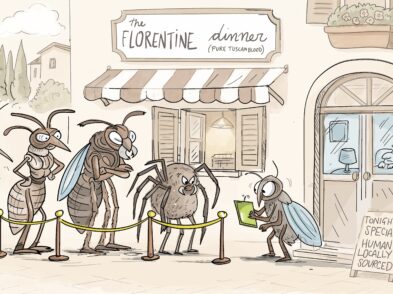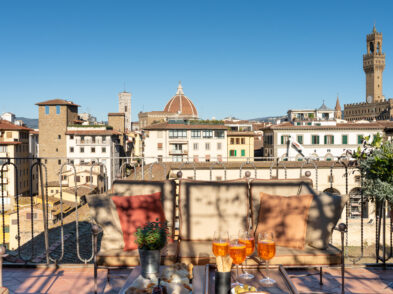
On summer mornings, I sit at my sixth-floor window and welcome my breakfast visitors. They come uninvited, adorable, elegant and mostly dressed in black. A few sport a red foulard beneath the chin. I am quiet in the morning, but they talk a lot, filling the conversational space as they twitter around me, sometimes screaming with communal laughter. They have a better view of Florence than me. Mine, although high up, is contaminated by poorly kept balconies and a confusion of electronics (antennae, swooping wires, discs and phone masts), but theirs is an ever-changing panorama of Florentine towers and terracotta roofs. Much better than Google Maps or expensive hot air balloons. These fine weather tourists have been coming to Florence forever, but things are changing. Each year there are fewer and they don’t stay as long. Are they losing interest in the architecture or is there something more sinister going on? Can we learn from them and is there something we could do to persuade the human tourists to do the same? Many of us would prefer more swifts, more swallows, and fewer people.

In the city centre, birds of nearly every kind are on the decline, regardless of whether you blame insecticides, farming, climate, pollution, architects or cats. It isn’t all bad news, however. In the outskirts and the surrounding hills, forests are expanding and some birds are flourishing. Nightingales are holding their own, singing to each other, if not to us. Pigeons are adapting to city life. You may have noticed that they seem to be getting darker than their country cousins. The experts say it’s all about melanin. The pigment behind a summer tan also protects the pigeons from toxic metals in their diet as they peck the urban dust. The black and tan pigeons on my roof are courting earlier every year and getting uglier. There are lots of them and they mate for life. Maybe, like humans, once they have found a mate, they no longer bother about their appearance. The mating season over, the pigeons sit there looking bored as the breakfast swifts swirl past. Some say the swifts are hunting early morning insects, but I think they are playing, enjoying the aerobatics and practising for migration.
Florence has more hooded crows, magpies and jackdaws, useful scavengers, clearing the streets of abandoned food and disposing of the corpses of fallen pigeons. They are smart, noisy and, like so much of wildlife, there is a balance. When a pigeon built a nest on the ledge outside my bathroom window, a thieving magpie stole the eggs and came back later to fly off with the fledglings. A mixed blessing. Do I want more dark and ugly pigeons or more smart magpies?
Then there are the other recent immigrants, the ring-necked parakeets. Unfortunately, they, too, upset the equilibrium by occupying songbird nests and driving them away. They give us thrilling flashes of green in the Boboli Gardens. I just wish they would invite their brilliant blue and yellow cousins as there is already enough green in Boboli.
Before the bad news, first have a look at the Arno where you will find plenty of lovely waterbirds. There are powerful black cormorants hanging out their wings to dry, and just south of the Ponte alla Carraia is a nest of kingfishers. White egrets as elegant as ballerinas are there too.
Some owls still inhabit the many parks and gardens in Florence. Except for the very centre of town, you can hear them hooting in the evening. But what has happened to the dawn chorus? Insecticides mean fewer caterpillars, so there are few blackbirds, thrushes and almost no warblers. The cuckoos are in trouble too. Fewer songbirds means fewer nests to colonize and fewer surrogate parents. The biggest falls have been in starlings and sparrows; both populations have halved over the past 30 years. One of the most marvellous city sights are the huge clouds of starlings that fly in beautiful formations over the Arno as they come into the city to roost in autumn. Happily, there are still enough starlings to cause national emergencies and the streets of Rome sometimes have to be closed because of the millions of slippery droppings.
Sparrows are the unofficial national bird of Italy with the sad history of a favourite food. The Romans used to chew on them during a day out at the gladiators. For thousands of years, they remained a special delicacy and I can remember being served a row of them roasted on a spit, their tiny feet in the air. They were delicious and I was told to pop them in as a single mouthful, noisily crunching their bones. It is horrifying to realize that they and other songbirds used to be trapped as they migrated across the Italian land bridge between Africa and Europe. The slaughter almost destroyed one of the main migratory routes and only ended when a law was passed in 1992, making it illegal. Yes, sparrows are no longer on the menu. Since then, there has been slow recovery, but the numbers may never get back to what they were.
We need sparrows as they have always had a strange relationship with death, acting as psychopomps, sometimes amassing outside a house where someone is dying so that they can guide the soul to the underworld, good souls they lift up to heaven. My friend Cati found a sparrow knocking on her window after the death of her husband. This went on for several weeks, only one tactful sparrow, not a crowd. The day after my wife died, a pigeon flew into my flat and refused to leave. I tried to shoo him out, but he stayed all day. Later he flew away, but came back for weeks before losing interest. Maybe he was filling in for the busy sparrows. This is one of the reasons I am so grateful to the swifts as they keep on coming.
Swifts are in trouble on many fronts. They cannot find the one thousand insects they need to catch every day, reduced by pesticides. They like to nest under roof tiles and in building crevices, so flat roofs, steel and glass are their enemies. They spend almost all their life in the air, first doing press ups in the nest to condition their wings for the long flight to Africa. They sleep on the wing using a cunning system of keeping half of their brain awake for navigation. They wash and mate in the air, swoop down to drink from swimming pools and keep the same partner for life. Maybe we should all do the same. Finally, there is the menace of bird’s nest soup. This Chinese delicacy is one of the most expensive foods on the planet (global trade $9 billion/year) and is made from the protein-rich saliva that swifts use to build their nests. The nests originally were harvested from caves, but now there are swift nest farms in Indonesia and Thailand. Although Prato has the largest Chinese population in Europe, thankfully bird’s nests are imported and never harvested in Italy.
What can we do to keep the bird numbers up? There are a few (too few) reasons to be optimistic. Last year, environmental and sustainability education became part of the Italian national school curriculum, and university courses in ecology are increasingly popular. Let’s hope this leads to a culture change and more songbirds. While we wait, here is some helpful advice from Maddalena, my ornithology consultant. All cats should wear a bell round their necks to warn the birds that they are prowling. Alpine farmers do the same with their cattle. Also, neck bells might be a good idea to warn us Florentines that a cruise ship crowd is on its way.
Trigger warning: bird translations can cause problems.
A wagtail is called a ballerina in Italian and the word uccello has a naughty double meaning. Even well-brought-up Italians will giggle when you say “a bird in the hand is worth two in the bush”.