In the last of her books she saw published in 1940, a biography of Roger Fry, Virginia Woolf described him as an “iridescent man”. A painter, art historian and critic, and expert in aesthetics, Fry introduced Post- Impressionist art (a term he coined) to England with the controversial exhibition he organized at London’s Grafton Galleries in 1910. A second exhibition on the theme would follow two years later. He also became a prominent exponent of Paul Cézanne. Woolf had first met him during the same year as the show at the Grafton because he had become an influential member of the Bloomsbury Group and a co-founder of the Omega Workshops, which ran for six years from 1913 with the aim of bringing art and craft together. It appears that, on her family’s insistence, in her profile of him, Virginia did not mention that he was also once the lover of one of her sisters, Vanessa Bell.
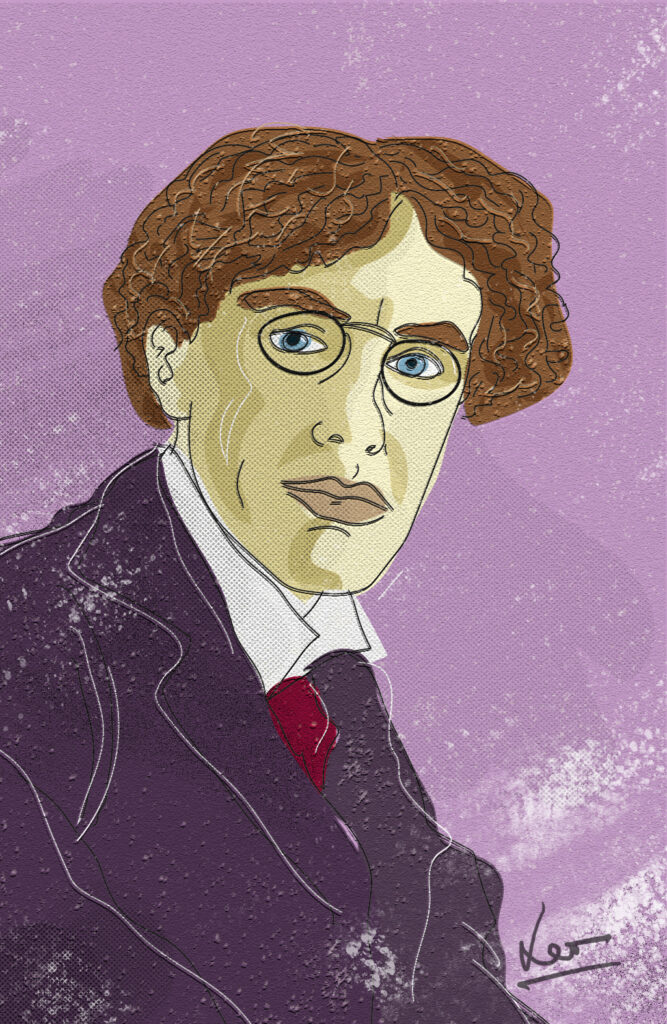
Born into a wealthy Quaker family in London on December 14, 1866, the son of a judge and zoologist, Fry was educated at Clifton College before attending King’s College, Cambridge, where he developed his interest in the arts while studying the Naturalist school of painting under Francis Bate (1853–1950) at his art school in Hammersmith, in 1889. After graduating in Natural Sciences, his father financed his first trip to Italy in 1891 before leaving for Paris to study art at the Académie Julian de Paris the following year, specializing in landscape painting. In 1894, he returned to Italy to continue his studies in art. That same year, he was focusing on the Old Masters and began lecturing for the Cambridge Extension Movement, while also gradually developing his passion for design.
In 1896, Fry married the decorative artist and stained-glass window designer, Helen Coombe, with whom he went on to have two children, who were cared for by their father with the help of his sister, Joan, after their mother was committed to a mental asylum in 1910 until her death in 1937.
In the early 1900s, Fry taught art history at the University College London’s Slade School of Fine Art, leaving when he was appointed Curator of Paintings at the Metropolitan Museum of Art in New York in 1906, a position he held until 1909. While there he oversaw a series of important art acquisitions for the museum.
In 1903, he became a founder of The Burlington Magazine, the first British periodical dedicated to art history, becoming co-editor between 1909 and 1919. He was also the art critic for the literary review,
The Athenaeum from 1901 until 1906. Some of Fry’s extensive literary output includes his books Vision and Design (1920), The Artist and Psycho-analysis (1924), Transformations: Critical and Speculative Essays on Art (1926), Cézanne: A Study of His Development (1927), Henri Matisse (1930), Characteristics of French Art (1932) and Reflections on British Painting (1934). In the late 1920s, he also became a radio broadcaster.
Throughout his career, Fry travelled frequently in Europe, especially to Italy and France, but also further afield including a trip to Turkey with the Bells to see Byzantine mosaics in 1911, where his affair with Vanessa began until she left him for Duncan Grant in 1913, nonetheless remaining lifelong friends. Earlier, in Florence, Fry had first met Bernard Berenson in 1897 and, in 1898, he and his wife stayed with the Berensons. For a time, he became a firm friend of Berenson, who encouraged him to publish his first groundbreaking book, Giovanni Bellini (1899). After the book was published, Fry was invited to write six articles on Italian art for the Monthly Review, which established his reputation as an art critic. Despite this, by 1902, Berenson had quarreled with Fry, suspecting that he had been used for his knowledge and experience without receiving the credit for them. This wrangle was renewed in 1903 when it seemed to Berenson that Fry had failed to support him over a dispute relating to the editorial policy at The Burlington Magazine.
According to Virginia Woolf, Fry became rather embittered and grumpy in his later years, caused, she believed, by ill health and hypochondria, the end of the Omega project, problems with his mistress, Helen Anrep, and disappointment at his failure as a painter. On September 9, 1934, Fry died in hospital after falling and breaking his pelvis at his home in London. His coffin was decorated by Vanessa Bell and his ashes were placed in a vault in the chapel of his alma mater in Cambridge. His art collection was bequeathed by his family to the Courtauld Institute of Art in London in 1958, where it can still be viewed today.