The Arno is Florence’s artery; the city was built around it and could not exist without it. But the relatively tame serpent that runs through the city today was a different beast in Pre-Roman times, wider and wilder, gorged by tributaries now hidden or diverted underground. Over millennia, the story of Florence is also the story of the struggle between the city and its waters, both shifting in relation to the other.
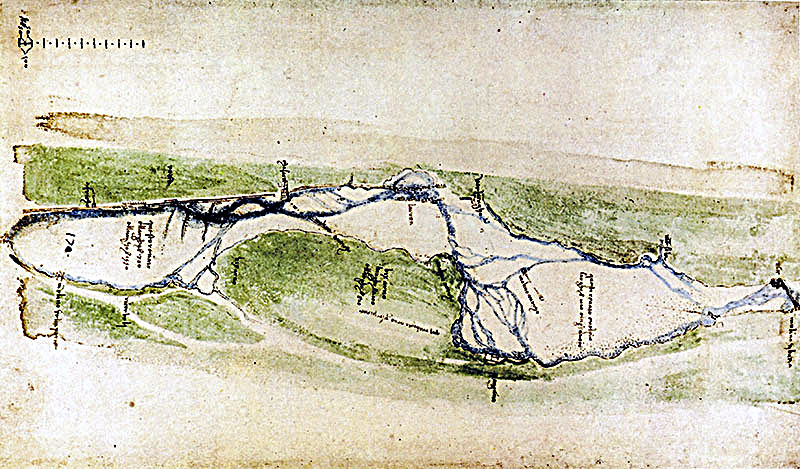
During the Quaternary period, the valley where Florence now lies was part of a vast lake stretching between Monte Albano, Monte Giovi and the foothills of Chianti. As it receded, it left behind meandering waters feeding a web of life that would later shape human settlement, chief among them the Arno, rising from the Casentino hills. Where the river met the lowlands of present-day Florence, seasonal floods and sediment deposits created a shifting network of channels and islets known as the Bisarni, temporary forms constantly eroded and rebuilt by the river’s moods. Their name derives from bis arnus, “double Arno”, referring to the points where the river divided into two branches before reuniting downstream. The neighbourhoods of Isolotto and Bellariva, as well as the site of Cascine Park, were once among these islets.
Within this aquatic cradle, the earliest inhabitants of Florence, Etruscans from the Villanovan culture, founded a settlement at the confluence of the Mugnone and the Arno, near to where the Ponte Vecchio stands today, around the ninth century BCE. The Etruscans preferred higher ground; Fiesole (then Vipsul) was their main outpost, yet the site where the Arno narrowed offered a strategic crossing. When the Romans arrived in 59 BCE, they recognized the site’s value, settling on a sandy plateau 46 metres or so above sea level, elevated above the surrounding marshes of Santa Croce and San Salvi, near today’s piazza della Repubblica. It has been hypothesized that the Romans initially named this settlement Fluentia, after the flowing of the Arno and Mugnone rivers, before it evolved into Florentia.
The Mugnone, formed from several streams near via Faentina, once entered Florence through via San Gallo and flowed past piazza San Marco and via Cavour before joining the Arno near what is now the Uffizi. When the Romans built the first walls, they diverted it toward via de’ Cerretani, where it emptied near Ponte Santa Trinita, serving as a defensive moat. As the city grew, the Mugnone was redirected repeatedly: first along via dei Fossi in the 12th century, then under Arnolfo di Cambio, to skirt the new 13th-century walls along today’s viale Lavagnini and Porta al Prato, flowing into the Arno near today’s via Curtatone. The construction of the Fortezza da Basso forced another deviation toward San Jacopino in the 16th century, where it met the Terzolle before flowing into the Arno near the Cascine. By the 17th century, the river was pushed farther west to divert sewage away from the city, reaching its present mouth near Ponte all’Indiano.
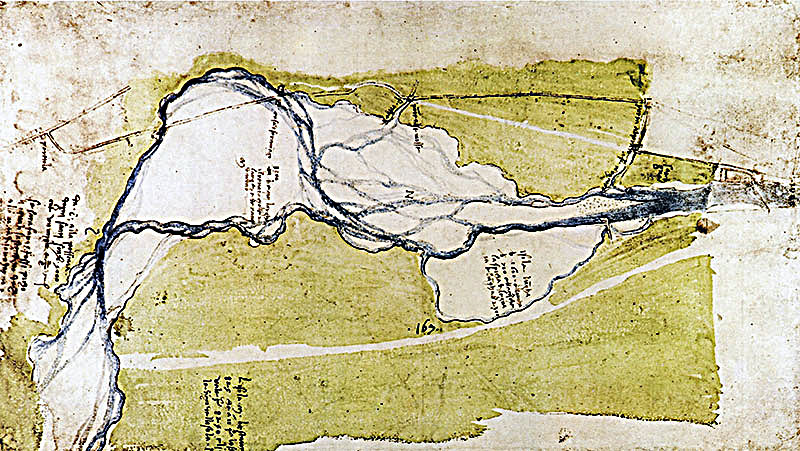
The water of the Mugnone, filtered through the stone of the hills, was ideal for the curandaii, leather workers and dyers who clustered along its banks in the area that took their name, Le Cure.
The aforementioned Terzolle descends from Monte Morello, fed by its tributary, the Terzolina, before passing Careggi and piazza Dalmazia. In Roman times it was known as Rives Frigidus (“the cold stream”), from which the modern district of Rifredi takes its name.
The poet Giovanni Boccaccio was greatly attached to the hilly landscapes and rivers to Florence’s north and east. His Ninfale Fiesolano transforms the Mensola and the nearby Affrico rivers into a myth about tragic lovers, encouraged by Venus but punished by Diana for their passion. The shepherd Affrico commits suicide by drowning himself in the river that takes his name, while the nymph Mensola is transformed into a river by the goddess of the hunt. Their child, Pruneo, would later found Fiesole, between the valleys of his parents’ namesakes. The Mugnone appears as Affrico’s ancestor, having suffered a similar fate.
Rising in San Domenico near via delle Fontanelle, the Affrico collects water from the hills of Camerata and winds through Campo di Marte and Bellariva before joining the Arno near Ponte di San Niccolò. The Mensola, born from the joining of the Fosso di Bucine and Fosso di Valonica near Monte Ceceri, runs past Villa I Tatti and the hamlet of Ponte a Mensola before slipping beneath the surface and emerging again near Rovezzano. Both of these rivers now flow mostly underground.
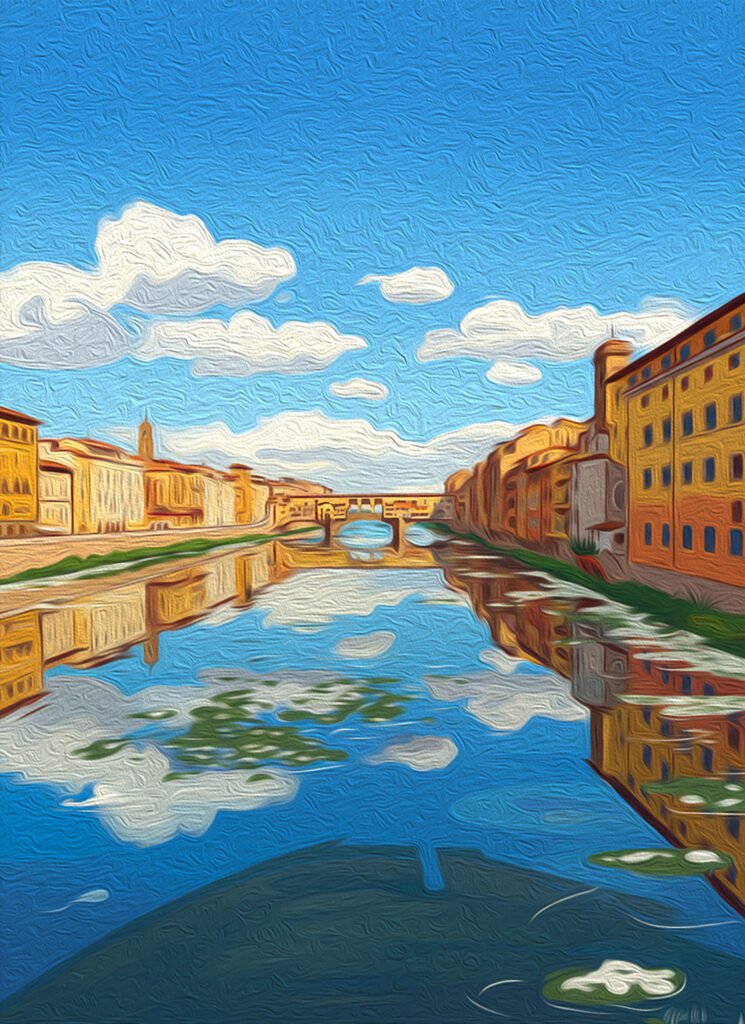
By the 19th and 20th centuries, Florence’s waterways had mostly disappeared from view. Giovanni Poggi’s urban renewal buried many of the minor streams, transforming them into culverts and drains. Yet the city’s relationship with water remains precarious. When the Arno burst its banks on November 4, 1966, the floodwaters reclaimed much of their ancient domain. Once marshy areas (the old beds of the Mugnone and Affrico, the lowlands of Santa Croce, Bellariva and the Cascine plain) were hit hardest. Modern flood maps confirmed the Romans’ wisdom, as the area around piazza della Repubblica, where they had originally settled, was one of the least inundated areas in 1966. Flood defences now hold the Arno mostly in check: tamed, but never subdued. Beneath the stones, the Affrico, Mensola and their kindred murmur through hidden channels, carrying memories of floods, myths and mills. Florence was born of their meeting.
Fossi of Florence
Beneath the modern city, a network of forgotten rivulets still threads.
Among them is the Fosso dell’Arcovata, descending from Montughi hill, near the Stibbert Museum, and merging with the Terzolle. Buried in 1908 during the construction of via Vittorio Emanuele II, it still runs unseen beneath the pavement. Nearby, the Fosso della Lastra flows down toward Careggi before vanishing into the Terzolle, while the Fosso del Pellegrino, whose source is near Villa La Pietra, disappears underground en route to the Mugnone. The Fosso di San Gervasio historically embraced the city’s eastern walls. From Camerata it flowed into piazza Edison and Campo di Marte, collecting swamp water on its way to Florence. Since Poggi’s intervention during Florence’s brief spell as the capital of Italy, it has been deviated underground at piazza Edison, flowing along viale Volta into the Mugnone. The Fosso Macinante, an 11-kilometre canal running along what is now Cascine Park, is an ambitious hydraulic feat dating to Renaissance Florence. It passes under the Mugnone and joins the Bisenzio, an early example of siphon engineering. Its name recalls the mill (macina) at Il Barco, once used by Manifattura Tabacchi to wash tobacco leaves. South of the Arno, the Fosso di San Rocco rises on Poggio Imperiale hill and crosses beneath the Oltrarno toward Ponte alla Carraia, while the Fosso di Carraia and its twin from the Erta Canina hillside join the river between Ponte di San Niccolò and Ponte alle Grazie. Eastward, the Fosso di Gamberaia and Fosso di Ricorboli once flowed openly down from the Pian dei Giullari and Santa Margherita a Montici hills before being covered in the 19th and 20th century.