A Renaissance painting damaged in the 1966 Florence flood is to undergo restoration thanks to a sponsorship by Officina Profumo-Farmaceutica di Santa Maria Novella. Saint Sebastian, painted by Francesco Botticini between 1475 and 1480, belongs to the Uffizi Galleries.
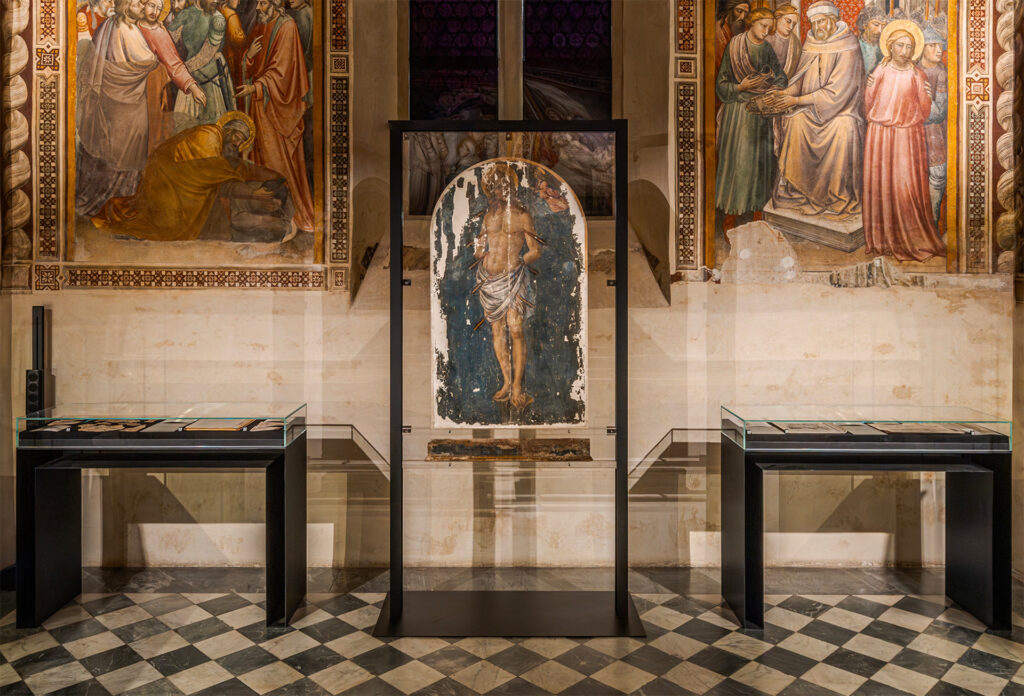
When the Arno burst its banks on November 4, 1966, the 127-by-76-centimetre panel was in the ground-floor rooms of the Uffizi known as the Vecchia Posta. It had been moved there in 1963 for a conservation assessment. Floodwaters left the paint fragile and fragmented, with mud even penetrating the holes left by woodworm. As the wooden panels shrank, the surface available for the paint to adhere to was also reduced.
In March 1967, a commission of experts decided to transfer the surviving paint layers onto a new support, with the backing of the Committee to Rescue Italian Art. The invasive procedure was reserved for artworks in a particularly poor condition and required the removal of the original wooden support. During the operation, the paint fragments were consolidated and the saint’s face reconstructed using recovered pieces.
The painting was moved to the Fortezza da Basso in June 1967, alongside numerous other artworks rescued from the flood. In 1975, the Restoration Laboratory of the Superintendency of Galleries merged with the Opificio delle Pietre Dure, which has safeguarded the panel ever since.
The forthcoming restoration will not erase the changes the painting has undergone. Instead, the sponsorship acknowledges its artistic and historical significance, including the traces of the disaster that have become part of its story.
The initiative also reflects the Officina’s own experience of the flood. Established in Florence in 1221, the historic perfumery was severely affected when water, mud and fuel oil inundated its premises at via della Scala 16 in November 1966, damaging laboratories, storerooms, the archive and historic rooms. Supporting the conservation of a work that suffered the same disaster is a way of recognizing the shared history of the institution and the city.
Before the restoration begins at the Opificio delle Pietre Dure, Saint Sebastian is on view in Frammenti non dimenticati. Firenze, 1966 (Unforgotten Fragments, Florence 1966), an exhibition at the Officina’s historic premises running until November 22. The display brings together photographs and documents relating to the flood, alongside objects from the company’s archive and collections. Among the exhibits are a 1755 document, an 1866 deed, product price lists from 1859 and 1874, and a photographic plate reproducing the diploma awarded at the 1900 Paris Universal Exposition. Visitors can also see flongs (cardboard matrices used to produce printing plates for advertising) as well as design cards for the 1965 Melograno soap box and a late 19th-century majolica jar made at the Ginori factory in Doccia, labelled “Allume di rocca pol.” Some objects still bear the marks of the flood, while others have since been restored.
The timetable for the restoration is still being defined. Once the work is complete, Saint Sebastian will return to the Uffizi Galleries, with a public presentation planned at a venue yet to be announced.