Galileo Galilei’s name is immortalized in textbooks, space missions, and even pop songs, yet few grasp the depth of how radically the astronomer from Pisa transformed the production of knowledge. The Galileo Museum in Florence offers an antidote. Here, Galileo emerges through instruments that once sat in the palm of his hand and went on to redraw the universe. Walking through the museum with Ilenia Ulivi, a guide whose precision mirrors the tools she describes (and whips out from her bag like Mary Poppins with a degree in astronomy), Galileo appears as a working scientist and, rather than celebrating his discoveries in hindsight, the museum reconstructs the uncertainty of the moment, charting the development of a method that would irrevocably alter humanity’s relationship with the universe.

The astrolabe dominates the early rooms, including Galileo’s own, calibrated for the latitude of Florence. It was essentially a computer, able to calculate stellar positions, determine time, establish latitude using the Pole Star, and even assist with astrology. Galileo himself prepared horoscopes for the Medici court, a reminder that astronomy and astrology were once intertwined, just like alchemy and chemistry. Nearby celestial globes translate the sky into three dimensions, while timekeeping devices based on the movement of astral bodies reveal how astronomy governed daily life. The nocturnal, calibrated by date and guided by the stars of Ursa Major, allowed travellers to tell the hour at night. “It was Google Maps for the past,” Ulivi says.
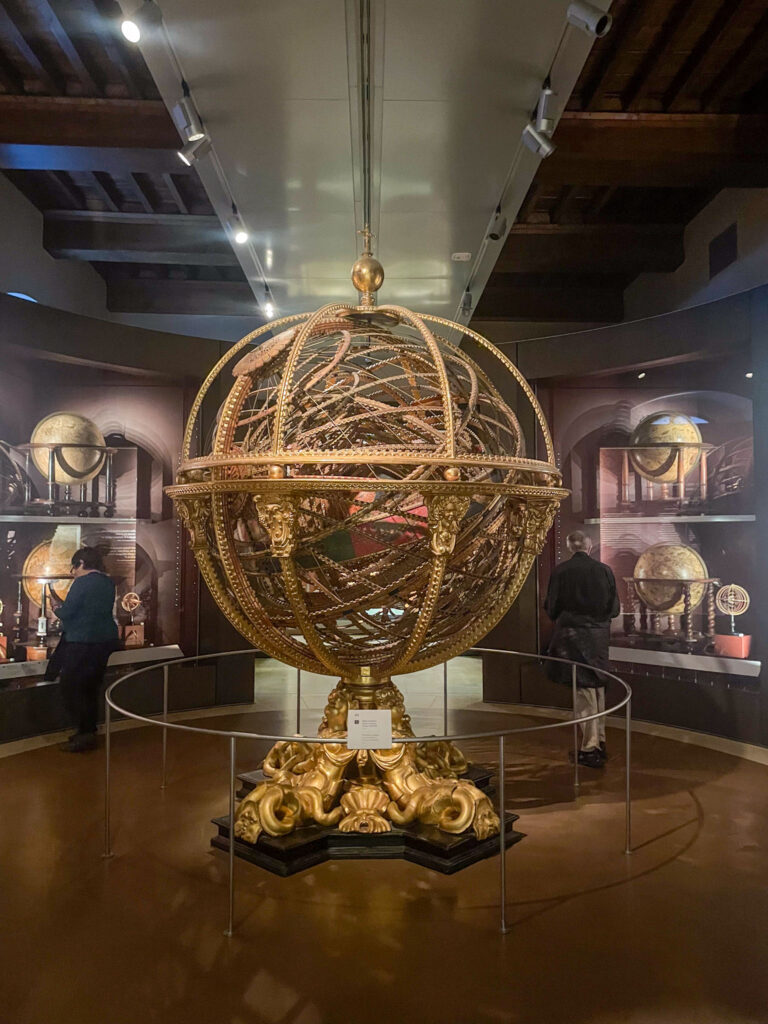
One of the most imposing objects is the great armillary sphere made for Grand Duchess Christina of Lorraine. Crafted from gilded wood, it represents the universe according to the geocentric model: Earth at the centre, surrounded by concentric spheres carrying the Moon, planets, Sun, fixed stars and, finally, the divine mover beyond. “It’s important to understand,” Ulivi explains, “that this was not fantasy. As a mathematical model, the Ptolemaic system worked. The calculations aligned with what observers saw from Earth. Even today, we speak of the Sun rising and setting.” Galileo’s observations would soon reveal cracks in this ancient architecture.
Galileo was born in Pisa, but teaching at the University of Padua placed him within the Venetian Republic, near Venice and its exceptional glassmakers. This proximity gave him access to high-quality glass at exactly the right moment. When crude telescopes, dubbed “Dutch toys”, began circulating in Europe, Galileo radically improved them. Shopping lists found among his papers include beans and chickpeas alongside “flattened glass,” grinding powder and artillery balls used to polish lenses. By 1609, he had achieved magnifications of up to 30 times.
Galileo first presented the telescope as a weapon. From the bell tower of San Marco, he demonstrated it to the Doge of Venice, allowing him to spot enemy ships hours before they reached the lagoon. One room of the museum is dedicated to the science of war. Galileo was the first to understand that a projectile follows a parabolic trajectory. His geometric and military compass allowed gunners to calculate range based on the angle of elevation. This same insistence on measurement defined his work on motion. The famous inclined plane demonstrates his discovery that falling bodies accelerate uniformly, regardless of weight: hypothesis, testing, confirmation, law.
The heart of the museum lies in the room dedicated to Galileo himself. Two slender tubes rest in a case: the only surviving telescopes built by Galileo. Nearby, framed like a relic, is the cracked objective lens with which he discovered the moons of Jupiter. Seeing these objects in person is striking: they are not replicas, but the very tools that shifted humanity’s place in the cosmos. Named the Medicean Stars, Jupiter’s moons secured Galileo’s appointment as court scientist in Florence. More importantly, they proved that not everything revolved around Earth. Observations of Venus’ phases later confirmed its orbit around the Sun, shattering the geocentric model.
 Bust of Galileo with his telescopes in the background
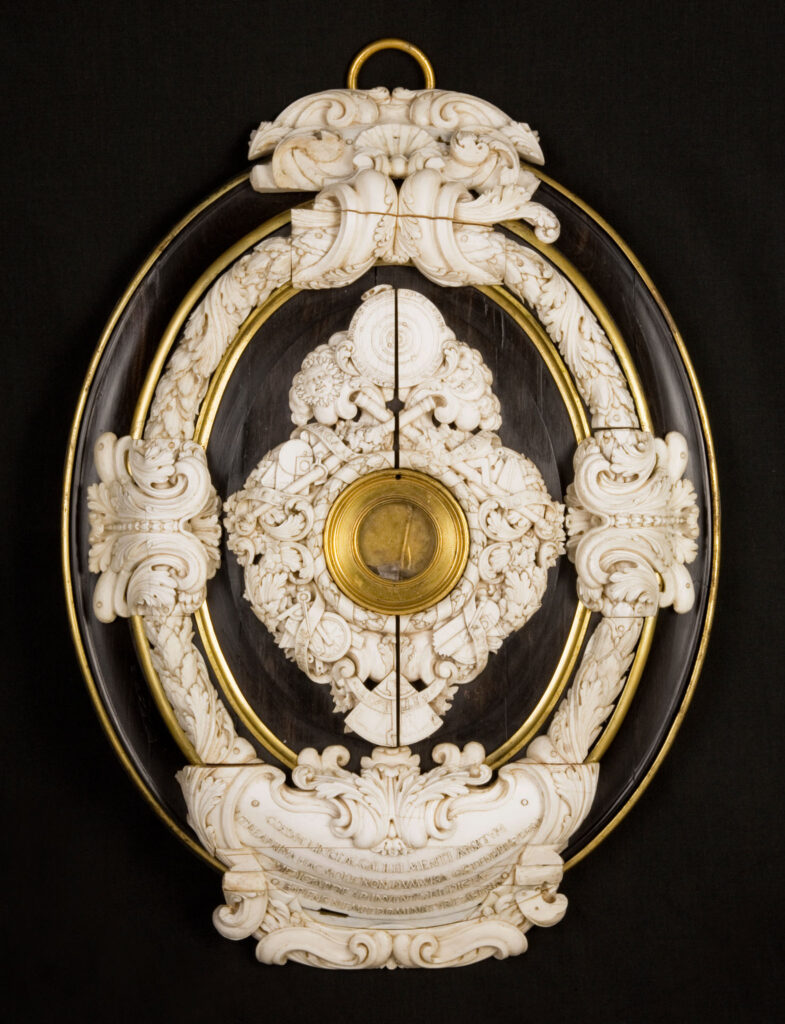 The lens Galileo used to discover Jupiter’s moons
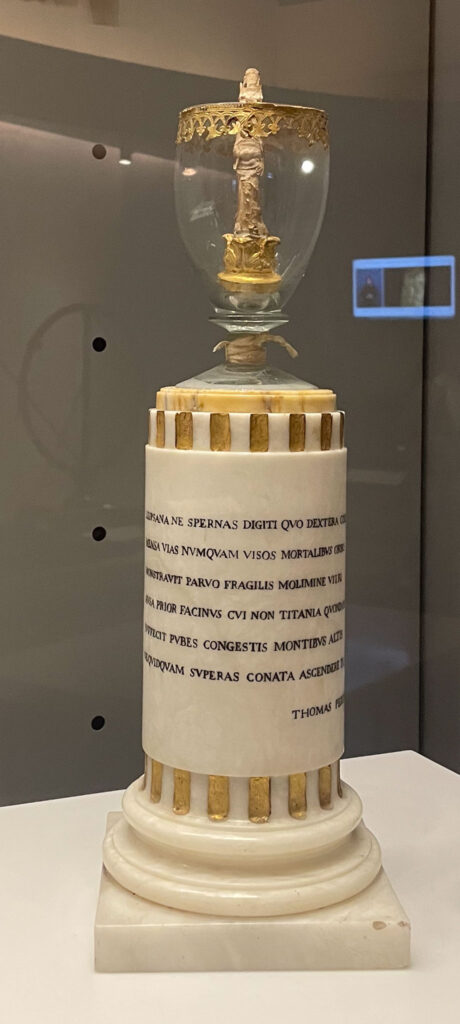 Relic of Galileo’s middle finger
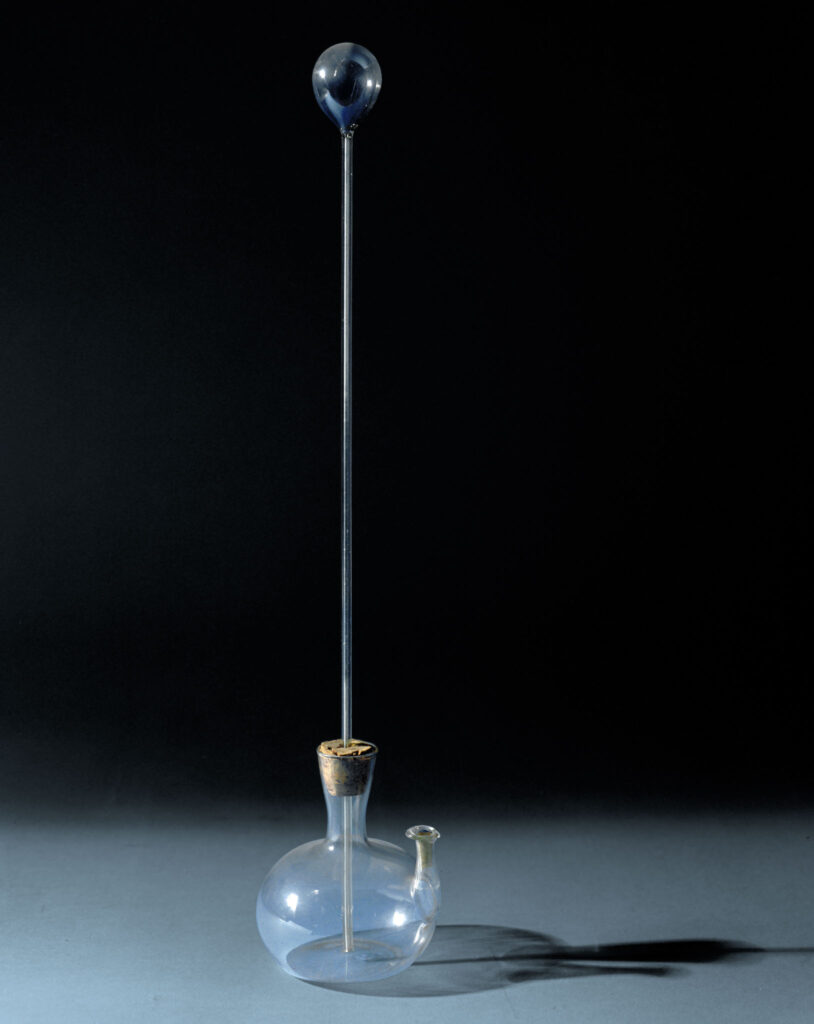 Thermoscope
 Jovilabe
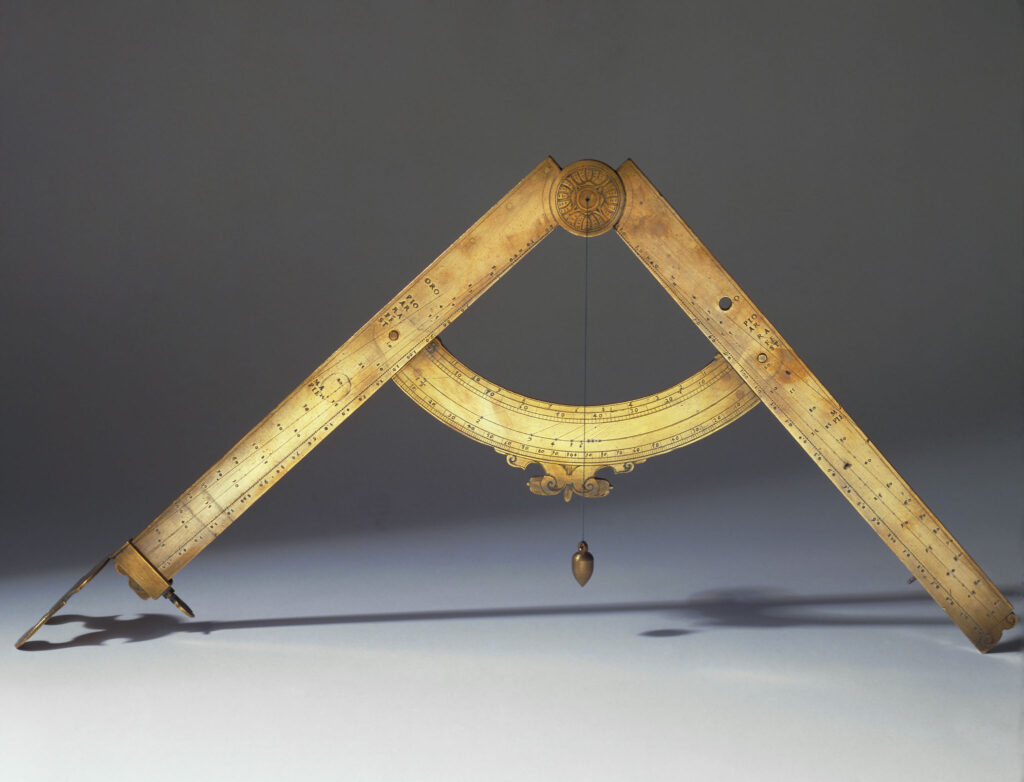 Compass
 The outside of the Galileo Museum
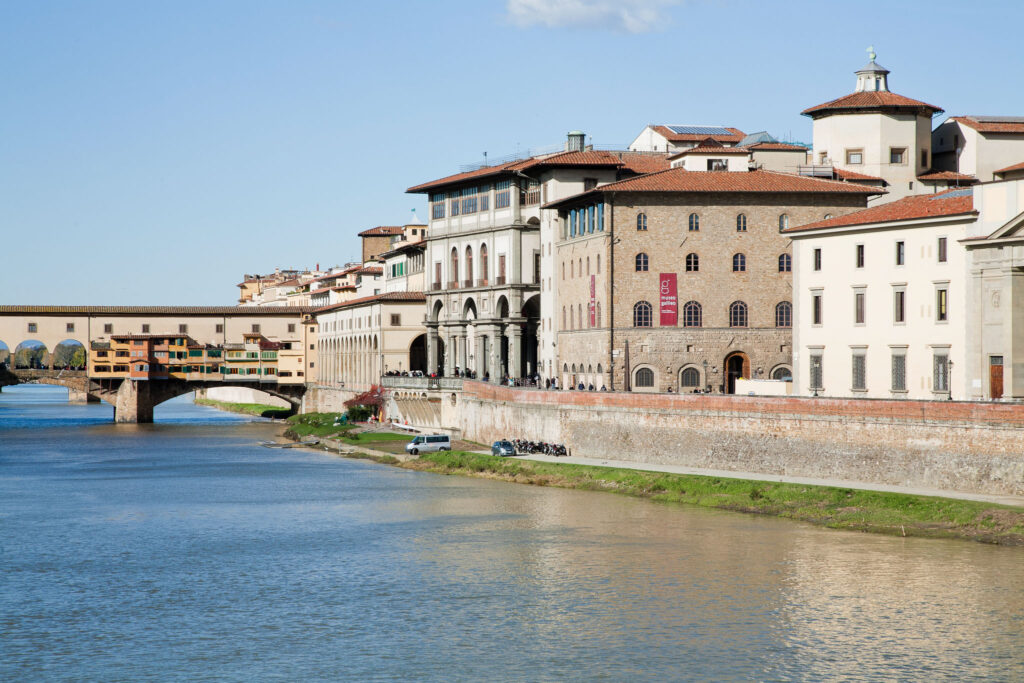 Galileo Museum on the Lungarno
Galileo’s discoveries dismantled Aristotle’s perfect heavens and challenged their theological interpretations. This was a religious problem: his observations disrupted a cosmos long aligned with scripture and ecclesiastical authority. After publishing Dialogue Concerning the Two Chief World Systems, Galileo was tried by the Roman Inquisition, forced to recant and confined to house arrest in Villa Arcetri for the final eight years of his life.
Even under confinement, he studied pendulums, temperature and motion, laying foundations that others would build upon. His thermoscope, a proto-thermometer, used the thermal expansion of liquids to measure temperature, while his innovations with lenses led to microscopes, opening entire realms in chemistry, medicine and beyond. His students, including Torricelli, went on to invent the barometer and deepen the study of atmospheric pressure.
Galileo died in 1642. When his remains were transferred nearly a century later to a monumental tomb in Santa Croce, admirers removed relics from his skeleton. His middle finger, raised in perpetuity, is now displayed at the Galileo Museum. As unsettling as it is fitting, it points to the heavens he dedicated his life to observing, and perhaps offers some scorn toward his detractors.