On Florence’s via della Spada, in the long shadow of Santa Maria Novella, a passer-by could be forgiven for overlooking the unassuming church of San Pancrazio. Built of pietra forte, which habitually peers through flaking plaster, the building seems unremarkable beside its more celebrated neighbour. Later interventions only deepen this impression: an irregular succession of rectangular and arched windows, a hastily blocked doorway and a monumental Romanesque entrance flanked by the shattered remnants of antique lions lend the whole a strange, unbalanced aspect. It is precisely this exterior that makes what is concealed within all the more remarkable. Ascending the stairs and passing through the Marino Marini Museum, a visitor is confronted with one of the most unusual monuments in Florence: the Tempietto del Santo Sepolcro.
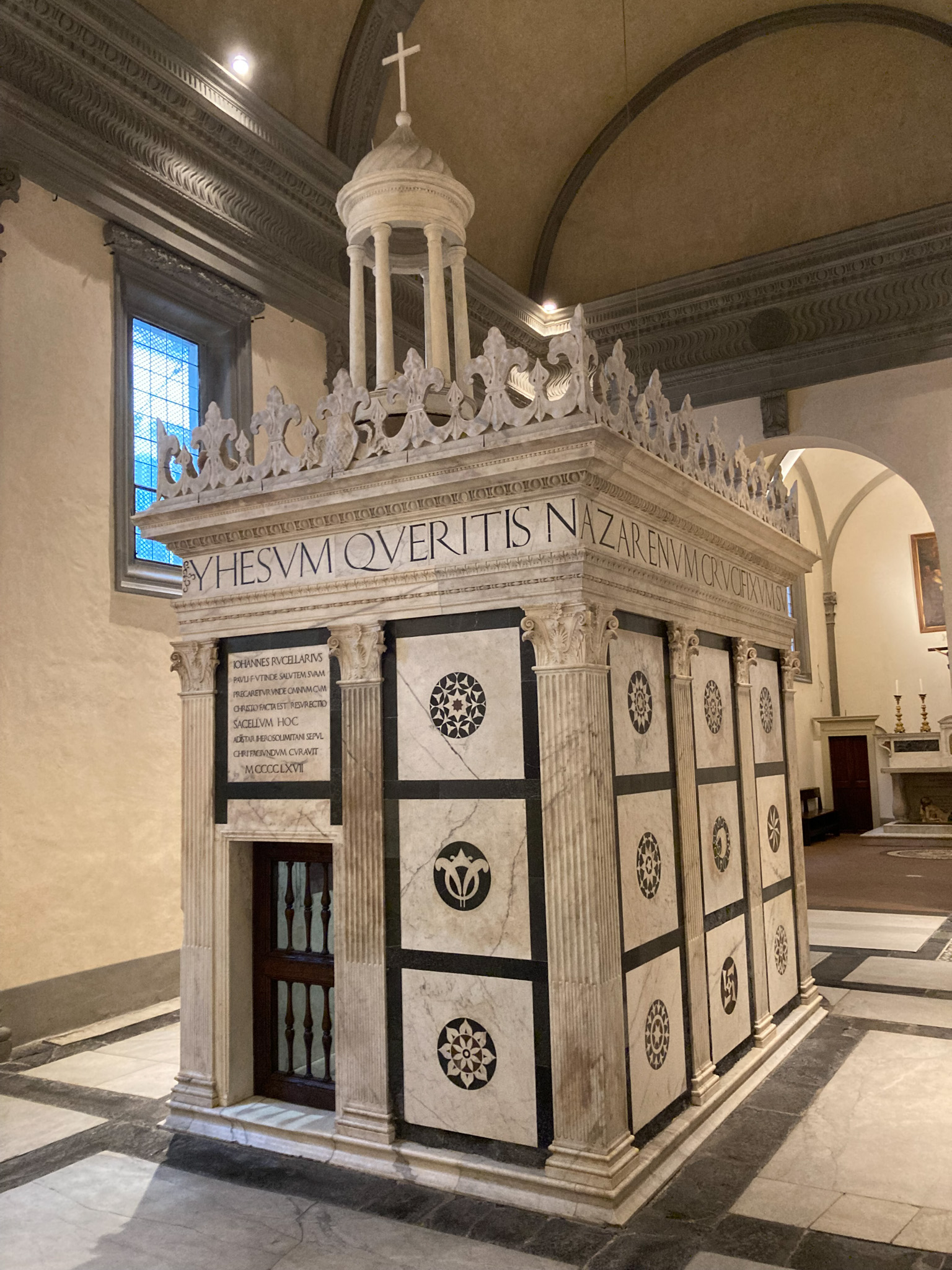
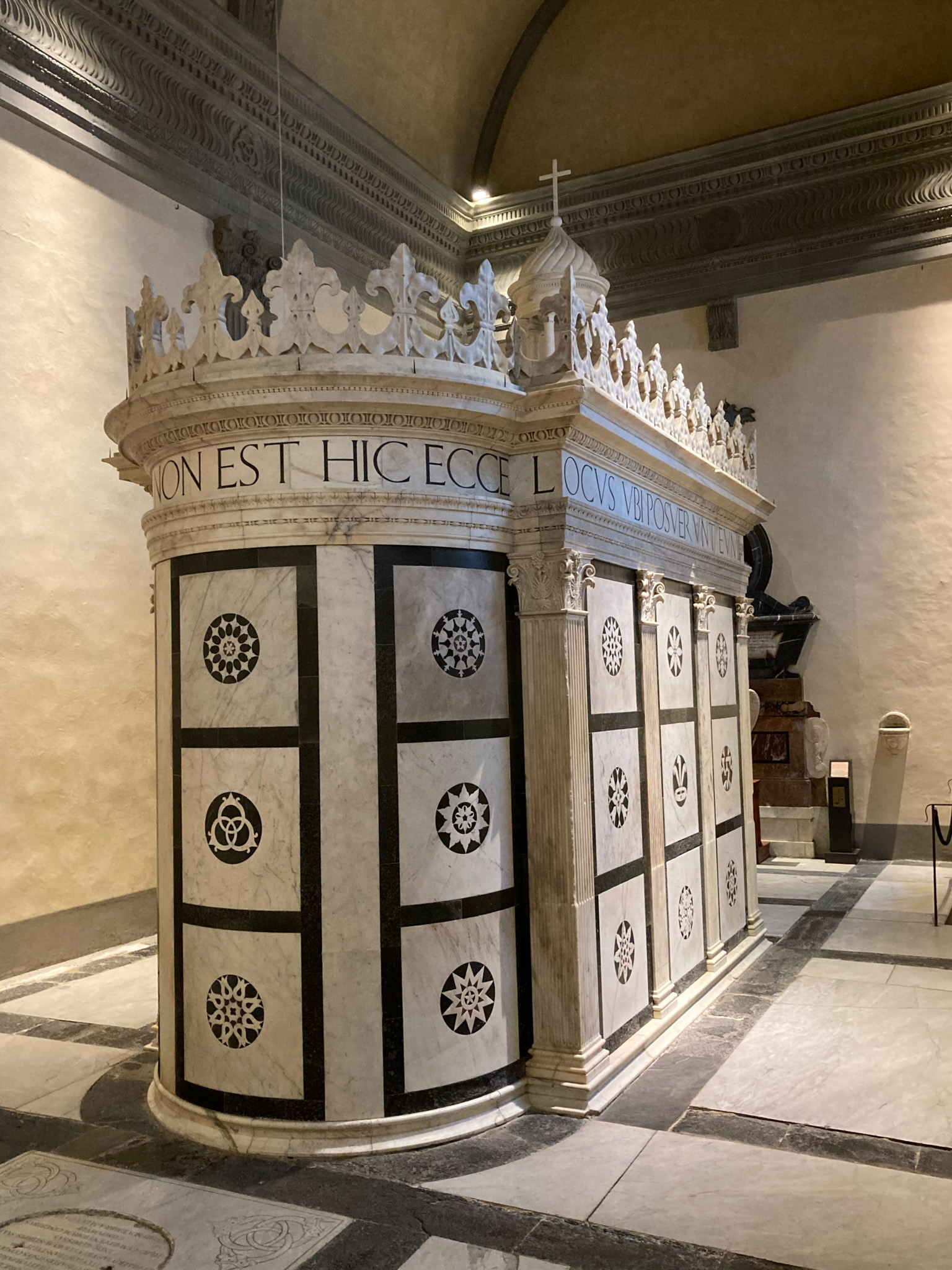
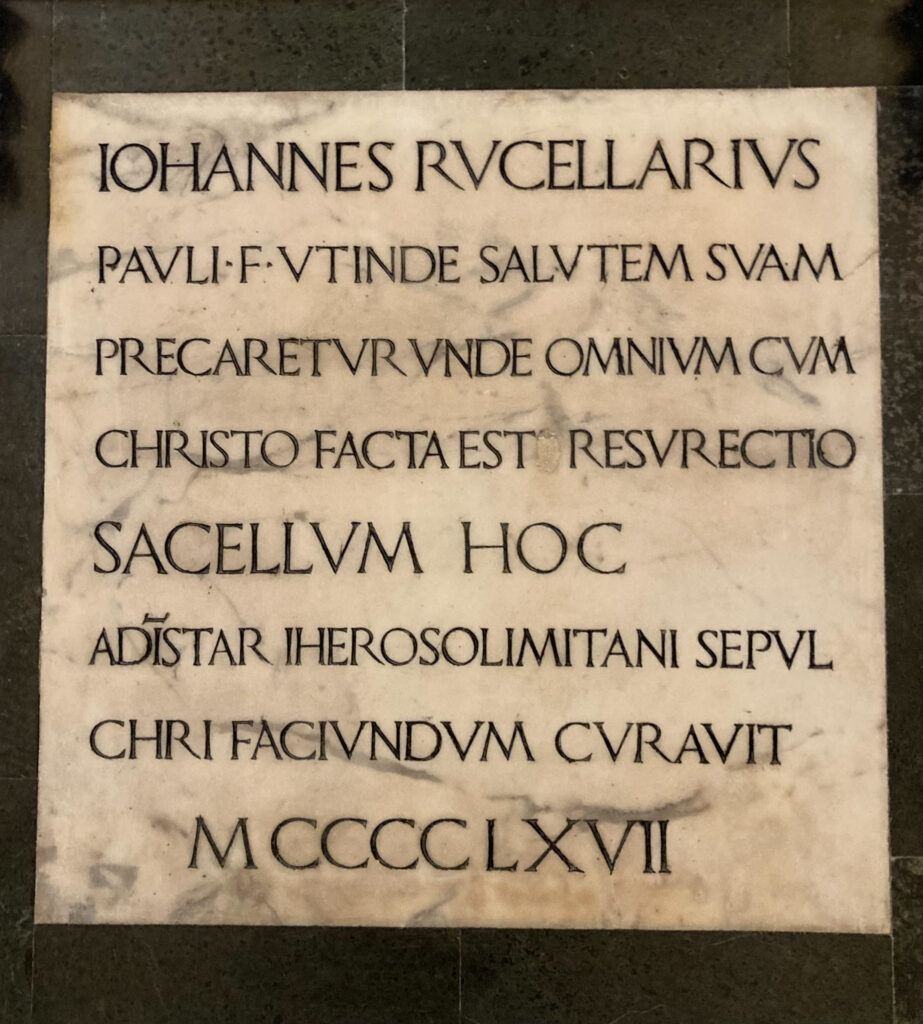
The monument in question is an edifice of Carrara marble, its walls inlaid with Corinthian pilasters, between which appear square tripartite panels outlined in serpentinite holding intricate intarsia motifs. Above, it is crowned by a repeating frieze of fleur-de-lis sculpture over which rises a slender cupola, supported by six marble columns and surmounted by a cross. A continuous inscription, carved in capitalis monumentalis, runs around the structure, offering a first indication of the building’s purpose: “You seek Jesus of Nazareth, the Crucified; he has risen and is not here. This is the place where they laid him”. As the inscription then curves around the apse toward a low-cut entrance, the visitor is met with an unequivocal declaration: “Giovanni Rucellai, son of Paolo, had this chapel fashioned in the likeness of the Holy Sepulchre of Jerusalem, to pray for his salvation at the very place from which the resurrection of all began with Christ. 1467”.
Inside, this symbolism is made manifest: beneath a canopy of stars, a fresco depicts the same Giovanni Rucellai tenderly cradling the body of Christ beneath the cross. To the right, a simple and empty slab evokes the moment of the Resurrection, above which Christ, flanked by angels, ascends toward heaven. The events represented here took place far from Renaissance Florence, in the ancient Roman province of Judaea, in the city of Jerusalem. As the locus of Christ’s preaching, crucifixion and resurrection—Christianity’s very foundation—the city exercised a special fascination on the minds of the faithful. It was both a spiritual homeland and the site of the “New Jerusalem”, the promised city that would descend from heaven at the end of time. It functioned not merely as a physical location, but as a symbol of the world to come, orienting the faithful on their spiritual journey toward salvation and eternal life.
This motif was immensely powerful. From as early as the fourth century, pilgrims from the Latin West—foremost among them Helena, the mother of the Roman emperor Constantine—journeyed to the Holy Land in the belief that they were, in a profound sense, returning home. Such ideas proved an enduring influence on religious and cultural life in Latin Europe and, from the time of the First Crusade, assumed an overt political dimension. Jerusalem came to be understood not only as a spiritual home, but also as a place to be “recovered” from the Muslims. These convictions culminated in the city, together with a broad swathe of the Levant, falling under Latin-Christian domination between the late-11th and 13th centuries.
This geopolitical landscape had shifted dramatically by the time of the sepulchre’s construction. The remnants of the crusader armies clung to a precarious foothold on the island of Rhodes, while Jerusalem itself—captured and lost twice over—had been under Mamlūk control since 1260. Contemporary travel accounts attest that Latin-Christian travellers in the Holy Land now faced an increasingly hostile environment. Threatened by Muslim fleets at sea and dependent upon the goodwill of local elites once ashore, pilgrimage had become both dangerous and costly.
Despite his evident yearning for the Holy City, Giovanni Rucellai, who spent nearly all his life in the immediate orbit of Florence’s banking houses, did not risk this perilous journey. Instead, he entrusted the architect Leon Battista Alberti with a more ambitious undertaking: the transplanting of Jerusalem’s very sanctity to the banks of the Arno.
Alberti had learned his craft in Rome under the influence of Pope Nicholas V, to whom he dedicated his treatise De re aedificatoria. In it he argued that architecture was a means of translating authority and sacred truth across space and time. This was a vision of pressing contemporary relevance. In 1453, scarcely a year after the completion of his volume, Christendom’s eastern capital, Constantinople, fell to the Ottomans. In response, the papacy set about fashioning Rome as the centre of the Christian world with the transformation of the modest fourth-century basilica of San Pietro in Vaticano into a “New Jerusalem”, whose claims to supremacy were articulated through an architectural programme of astonishing clarity.
What Alberti learned in Rome, he gave form to in Florence. In the inconspicuous setting of San Pancrazio, the sacred geography of a Middle Eastern metropolis was physically imposed onto a European urban landscape. Unlike earlier medieval examples, such as Santo Stefano in Bologna, the Tempietto did not merely evoke Jerusalem through analogy and ritual. Its form instead offered an image of the Holy Sepulchre as a pilgrim might have encountered it in Jerusalem itself. This claim to authenticity was formally endorsed by the papacy: indulgences, traditionally attached to pilgrimage in the Holy Land, were extended to those who prayed at the sepulchre. Thus, as crossing the Mediterranean from west to east became increasingly difficult, Jerusalem’s authority was asserted through substitution, offering a credible architectural surrogate through which those unable to reach the city could commune with their spiritual homeland, in both life and death.