In the spring of 1181 or 1182, in the hill town of Assisi, a wealthy cloth merchant’s son was born into comfort and expectation. Baptized Giovanni but quickly nicknamed Francesco by his father, he grew up drawn to finery, music and dreams of knighthood. Few could have imagined that this pleasure-loving youth would become one of the most radical spiritual figures in Christian history.

His early life unfolded against a backdrop of civic unrest. Captured during a conflict between Assisi and Perugia, Francis spent months in captivity, emerging physically weakened and spiritually unsettled. Illness soon followed, deepening a crisis that led him to question the values of wealth and status that had once defined him. The turning point came in his early twenties when, praying in the dilapidated church of San Damiano, he is said to have heard Christ’s call to “rebuild my Church”. Taking the command literally, he sold cloth from his father’s business to fund repairs, prompting a dramatic public break with his family. Renouncing his inheritance before the local bishop, he stripped off his fine clothes and embraced a life of radical poverty.
What followed was a new and uncompromising vision of Christian life. Francis wandered the countryside preaching humility, repentance and joy, often barefoot and clad in rough garments. His message—live the Gospel without compromise—drew followers, and what began as a small fraternity grew into the Franciscan Order. Unlike traditional monastic communities, the Franciscans lived among the people, preaching in towns and fields, and relying on alms rather than property. His spirituality was marked by a profound sense of kinship with the natural world, captured in stories of preaching to birds and taming wolves, and in his poetic Canticle of the Creatures, composed late in life.
In 1209, Francis travelled to Rome, where Pope Innocent III granted informal approval for his rule, allowing the movement to spread rapidly across Europe. Yet growth brought tension, as pressures mounted to formalize the order and relax its strict embrace of poverty, developments that troubled its founder. In 1224, during a retreat on Mount La Verna, Francis reportedly received the stigmata, the wounds of Christ, a defining moment that symbolized his profound identification with suffering and devotion. By then in failing health, nearly blind and in constant pain, he returned to Assisi, where he died on October 3, 1226, aged about 44. Within two years, he was canonized by Pope Gregory IX.
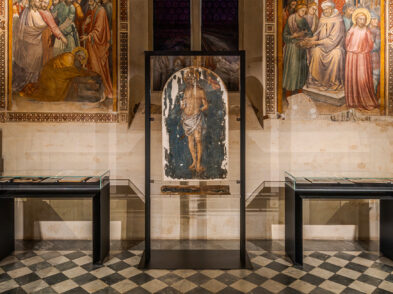
Eight centuries on, Francis’s legacy continues to resonate. At the Basilica of Saint Francis of Assisi, built over his tomb, pilgrims gathered in unprecedented numbers following the rare public display of his remains last month, an event unseen for centuries. Cultural commemorations have accompanied these religious observances, notably the exhibition Giotto and Saint Francis: A Revolution in 14th-Century Umbria at the Galleria Nazionale dell’Umbria in Perugia. Bringing together more than 60 works, the show examines the encounter between Francis’s spiritual vision and the artistic innovations of Giotto di Bondone, whose frescoes in Assisi marked a decisive break from Byzantine tradition and helped shape the course of western art, alongside contributions by Simone Martini and Pietro Lorenzetti.

The anniversary has also been marked by a wider programme of events, including the Franciscan Jubilee Year (2026–27), encouraging pilgrimage, reflection and renewed engagement with the saint’s ideals of poverty, peace and care for creation. Routes such as the Via di Francesco have seen a revival, while churches across central Italy have become focal points for liturgical celebrations. Italy has even reinstated October 4, Francis’s feast day, as a national holiday, underscoring his enduring significance.
Eight hundred years after his death, Francis of Assisi remains a figure who transcends time, a man who rejected wealth for simplicity, hierarchy for humility, and in doing so reshaped both religious life and the cultural imagination of Europe.
Franciscan Florence
Florence’s Franciscan heritage is best experienced through its two historic churches: the monumental Basilica of Santa Croce and the more intimate Church of Ognissanti. Santa Croce, founded in the late 13th century, became the city’s principal Franciscan hub, combining preaching, pastoral care and scholarship. Its vast nave welcomed large congregations, while frescoes by Giotto di Bondone (currently closed to the public for restoration purposes) and other Renaissance masters served as visual sermons. Ognissanti, also entrusted to the Franciscans in the 13th century, offered a quieter neighbourhood-focused ministry. Here the friars maintained daily liturgies, guided local devotion and embodied the Franciscan ideals of humility and service on a smaller, more intimate scale. The church preserves notable tombs and artworks, including those of Sandro Botticelli and Amerigo Vespucci.
Visit
San Francesco Vive website
Galleria Nazionale dell’Umbria
gallerianazionaledellumbria.it
Via di Francesco
Opera di Santa Croce
Chiesa di Ognissanti