Founded in 1852 in Florence by brothers Leopoldo, Giuseppe and Romualdo, Fratelli Alinari is widely regarded as the oldest photography company in the world still in operation. From its earliest years, the firm played a pioneering role in the dissemination of visual culture, systematically documenting artworks, architecture and cultural landmarks across Italy. Its images, renowned for their technical precision and clarity, helped shape international knowledge of Italian artistic heritage long before the advent of mass media.

Over the decades, Alinari expanded its activity beyond documentation to become a major photographic publisher and archive, acquiring collections and producing millions of prints. Today, the Alinari Archive constitutes one of the largest photographic repositories in existence, encompassing not only art reproductions but also portraits, landscapes and scenes of everyday life from the 19th century onwards.
In 2020, the Tuscany Region established the Fondazione Alinari per la Fotografia (FAF), which formally launched its activities in 2021. The foundation was created to preserve, study and promote this vast heritage through conservation, cataloguing and digitization, as well as exhibitions, scientific research and partnerships with leading institutions in Italy and abroad. Now, the foundation looks ahead to two new openings in Tuscany.
A dual future: Florence + Montecatini
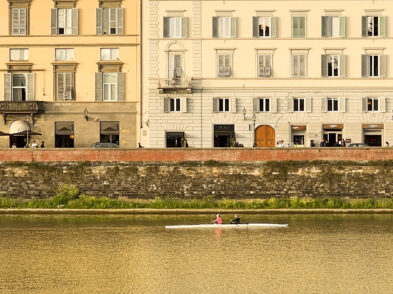
 Vincenzo Balocchi, Ponte Santa Trinita, Florence, February 1961. Florence, Alinari Archives – Balocchi Collection
 Fratelli Alinari, Staircase of the Tower of Arnolfo in Palazzo Vecchio and view of the Cathedral, c. 1900. Florence, Alinari Archives
 Fratelli Alinari, Print toning laboratory of the Fratelli Alinari photographic studio on Via Nazionale, 1899. Florence, Alinari Archives
 Fratelli Alinari, The façade of the Fratelli Alinari photographic studio at Via Nazionale 8 in Florence (now Largo Alinari), 1899. Florence, Alinari Archives
The future Alinari Museum will be located in the Santa Maria Novella complex in Florence, within the former School of Marshals building. As part of a broader urban regeneration project, the area is set to become a major cultural hub for the city. The foundation will occupy approximately 1,800 square metres, housing the museum alongside a significant portion of the photographic archive. The site will include a library featuring historic photo albums, research and consultation rooms, educational spaces, public services, a bookshop, a multifunctional hall and administrative offices. The architectural project is expected to be finalized by 2026, with construction scheduled for completion by 2028 and the museum opening to the public in 2029. The initiative is funded by the Tuscany Region, with support from Fondazione CR Firenze for cataloguing and museum design.
Alongside the Florence site, a second facility will be developed in the Tuscan spa town of Montecatini Terme, within the historic Terme Excelsior complex. Conceived as a Casa della Fotografia, this centre will house approximately two-thirds of the archive, including fragile materials such as photographic negatives requiring carefully controlled microclimatic conditions. It will also host restoration laboratories, digitization centres and advanced training programmes, completing the foundation’s future infrastructure.
Expanding exhibitions + research
 Wanda Wulz, Portrait of Amalia, called Maly, Levi Da Zara (1915–2003), wife of Giovanni Falck, c. 1928. Florence, Alinari Archives – Studio Wulz Collection
 Marion Wulz, Portrait of Wanda Wulz (1903–1984) in motorcycling attire, c. 1930–1932. Florence, Alinari Archives – Marion Wulz Collection
The foundation’s exhibition programme continues to expand both nationally and internationally. In 2026, a major exhibition on Michelangelo, recently presented in Carrara, will be revisited in Arezzo with a renewed focus on symbolism. Other projects include exhibitions in Paris and London, highlighting key photographic figures such as the Wulz sisters and Fosco Maraini.