Easter brought a first wave of seasonal tourists to Florence, and with them came a surprise. Between the city’s two most celebrated bridges, Ponte Vecchio and Ponte Santa Trinita, a long, white stripe now runs beneath the parapet walls of lungarno Acciaiuoli. The stones that once lined this stretch are now covered by a coat of bright paint applied during recent flood-proofing works. After the “black cube” development sparked widespread controversy a few months ago, the debate has now moved to the “white stripes”.
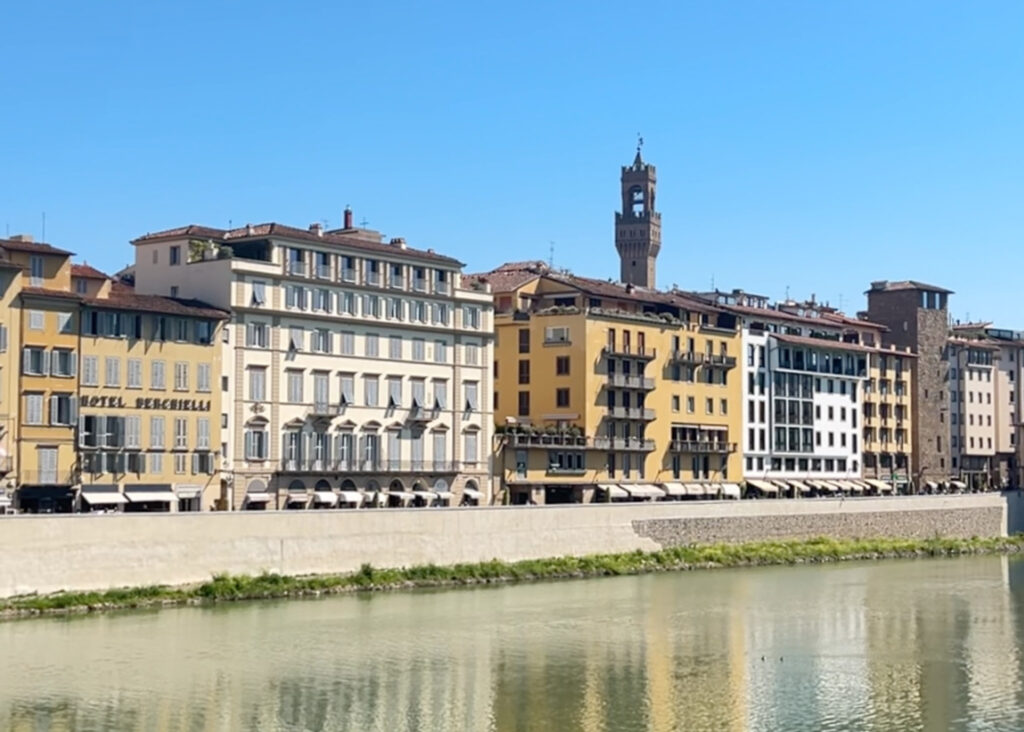
The works are part of a 14.7 euro million project, financed through Italy’s PNRR recovery fund and overseen by the Tuscany Region, to reduce the risk of flooding in Florence’s historic centre. Along the lungarno Diaz, lungarno delle Grazie and lungarno Acciaiuoli, engineers have reinforced the retaining walls, rebuilt the parapet structures and installed slots to accommodate portable flood barriers that can be deployed when the Arno rises.
Tuscany president Eugenio Giani has defended the broader effort as an exceptional flood protection programme that will safeguard the city from the kind of catastrophic flood that devastated the city in November 1966. He offered to convene a working group (including the Basin Authority, Florence’s city hall and the Soprintendenza) to agree on a different finish for the walls. He noted that the river itself would eventually darken the paint. The works are part of a much larger scheme, decades in the making: expansion basins at Pizziconi, Prulli and Restone are designed to hold a combined 15 million cubic metres of floodwater, with the Prulli basin recently breaking ground.
For many Florentines, the controversy is about more than colour. It touches on how decisions affecting a UNESCO World Heritage city are made, who is consulted, and whether safety and beauty can be reconciled. As tourists continue to arrive in their millions, Florence is asking how to protect something precious without diminishing it.