Michelangelo’s Sistine Chapel, one of the most celebrated painting cycles in the history of art, comes to life in a surprising new interpretation at the Casa Buonarroti exhibition, Michelangelo’s Sistine Chapel. A Multimedia Icon, scheduled from September 24, 2025, to January 7, 2026.

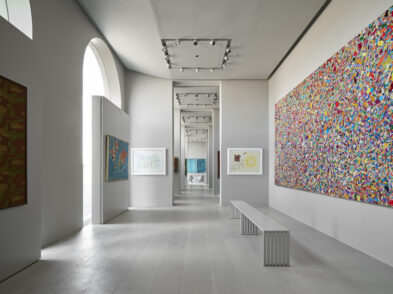
The exhibition, promoted by the Fondazione Casa Buonarroti in collaboration with the Vatican Museums and the Region of Tuscany, marks the inauguration of the restored exhibition rooms on the ground floor of the house museum in via Ghibellina.
With over 60 works, the exhibition offers a reinterpretation of one of the most monumental painting cycles in the history of Renaissance art through an evocative lens: the multimedia icon of Michelangelo’s Sistine Chapel. Media such as printmaking, photography, publishing, cinema, television documentaries and advertising campaigns have played a significant role in interpreting the complex pictorial narrative created by Buonarroti in the Vatican, spreading its visual documentation through dozens of fragments, individual frames and pictorial excerpts that take on new meanings, especially in contemporary times and within a social context that is largely indifferent to the exegetical reading of figurative art.

Among the exhibited works are numerous loans from the Accademia Albertina di Belle Arti in Turin, the Accademia delle Arti del Disegno in Florence, the Brera Academy of Fine Arts, the Florence Academy of Fine Arts, the National Academy of San Luca, the National Central Library “Vittorio Emanuele II”, the Hertziana Library, the Central Institute for Graphics, the Kunsthistorisches Institut and the Vatican Museums.
Michelangelo’s Vatican masterpiece has been, over the centuries, a constant figurative reference for artists. However, it was only in the 19th century, through the new medium of photography, that its knowledge spread globally. New perspectives began offering a precise and detailed reading of the work, highlighting details that, in the 20th century.

The copper plates for the etchings by Tommaso Piroli, Conrad Martin Metz and Giovanni Volpato, made between the late 18th and early 19th centuries, translate onto paper the grand figures of the Ceiling and the Last Judgment. However, it is photography—beginning with the first systematic documentation campaign carried out between 1868 and 1869 by the Alsatian firm of Adolphe Braun—that expands a repertoire of essential images for the study and historical-artistic understanding of Michelangelo’s work. The photographic campaigns of major Italian studios, such as Fratelli Alinari, Giacomo Brogi and Domenico Anderson, as well as the first illustrated publications with chromolithographic plates, like those promoted by the London-based Arundel Society, became tools for art historians and instrumental in creating the “myth” of Michelangelo.
The absence of colour tones was compensated by the large format of the negatives and, during printing, by adjusting the shades of toning or through manual colouring with aniline dyes, adding further layers of translation compared to the original work. From the mid-20th century onwards, Michelangelo’s colour palette was reproduced with relative approximation using orthochromatic film by Frank Lerner for the first colour photo shoot, which appeared in the popular magazine LIFE in 1949.

Fifteen years later, Pasquale De Antonis returned to the Sistine Chapel with art historian Roberto Salvini, working together on the first systematic scientific documentation campaign of Michelangelo’s painting cycle. That same year, in 1964, Carlo Ludovico Ragghianti created the critofilm dedicated to Michelangelo: “an art documentary in which cinematic language is used critically to offer the viewer the correct reading of a work,” as the author himself described it.
The widespread circulation of illustrations of Michelangelo’s work through scholarly and popular publications led to the artist’s visual language, widely recognized by mass culture, becoming a source of reworking by Tano Festa, one of the most prominent figures of Roman pop art. He anticipated the vulgarization process of certain details, such as the famous scene of the Creation of Adam, which became an iconic image absorbed into popular imagination and endlessly reproduced and reinterpreted in advertising, merchandising and souvenirs.
The eclectic and nonconformist art historian Leo Steinberg was a tireless scholar of Michelangelo’s printed legacy and among the first to regard the Sistine Chapel figures—without prejudice—as images of mass consumption, worthy of being collected (as he himself did from the 1960s) and studied in order to understand the deep cultural reception of the Tuscan master’s art in 20th-century society, from a history-of-taste perspective. On display are more than 40 reproductions from Steinberg’s collection of satirical prints, in which the iconic detail of the meeting between God’s and Adam’s right hands becomes, over the decades, a summary image, capturing the meaning, intensity and essence of the entire fresco, even while distorting its overall interpretation.
The last major photographic documentation campaign, begun in 1980 by Japanese photographer Takashi Okamura and completed in 1999 at the conclusion of one of the most celebrated restoration projects, highlights the “unveiling” of Michelangelo’s original work. In this reading, colour becomes the key to understanding his entire pictorial approach, revealing that beyond the line, it is the vibrant chromaticism, defining the volumes, and the daring colour juxtapositions that make this work a challenge even for contemporary eyes. A challenge taken up by Canadian artist Bill Armstrong, who, in 2015, invited by the Vatican Museums, interpreted Michelangelo’s masterpiece by focusing on individual figures and their gestures. He created a series of nine photographs titled Gestures, where the ethereal, out-of-focus quality—within which the resurrected men of the Last Judgment seem to float—is balanced by vivid chromatic tones that give shape to the bodies.
Finally, the exhibition concludes with the “photo-graphic” work Not in My Name, created in 2014 by Sudanese artist Khalid Albaih. Here, Michelangelo’s iconic image becomes a vehicle for a universal message, a call to reflect on the tragedy of the many wars that devastate populations and erode the sense of shared humanity.