Do you monitor your developmental milestones? When you were little, your parents recorded your first smile, first steps, first word, and so on. After a while, they lose interest, but you do not. You wait nervously for your first kiss, loss of virginity and driving licence. Then you, too, stop bothering, but the milestones keep coming, so sit up and take notice. This is what happens next: wrinkles and hangovers at 40, grey hairs and reading glasses at 50, followed by fading libido or hot flushes. After that, men have less hair on the head, more in the nose, mysteriously larger ears and night-time journeys to the bathroom. Around 70, names are harder to remember, and the vertical challenges begin. The time has come for you to pay attention to elevators and handrails.
Why, you may ask, should you care? The evidence is chilling. Stair accidents cause a million injuries every year in the U.S., not only sprains, bruises and fractures but 12,000 deaths, second only to car crashes. The worst fallers are the old or very young, but among university students, women out-fall men, perhaps because they are talking to a stair companion or maybe it’s the shoes. I have dealt with elevators, so now it’s time to share some important facts about Florentine handrails, starting with the museums.
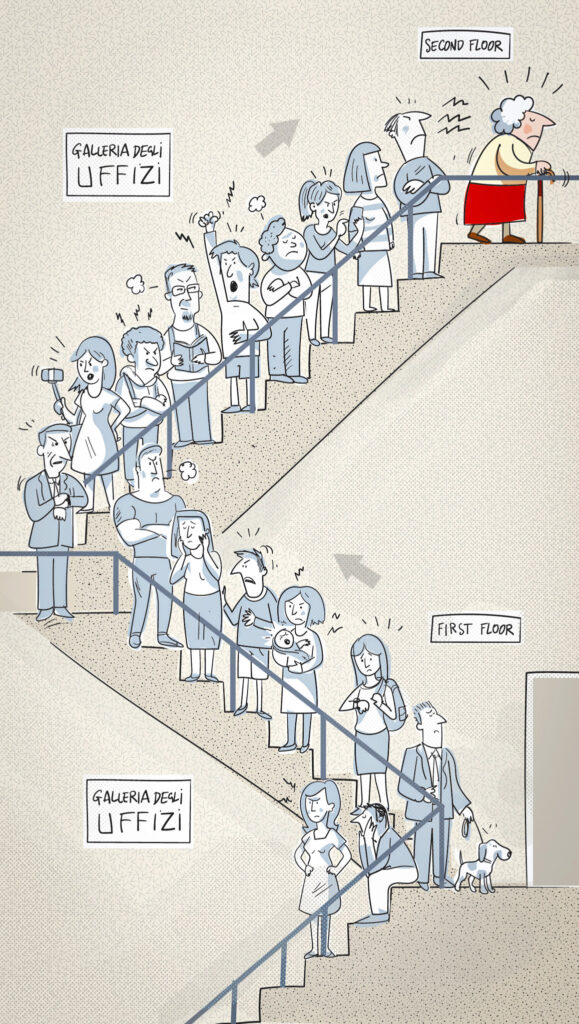
As the lift in the Uffizi is small and hard to find, almost everyone climbs the stairs, arriving on the second floor panting, sweating and cross. There is no formal handrail; instead a balustrade and stone support is sculpted into the wall. Both are darkened by sweaty hands and you cannot get a proper grip. Palazzo Pitti provides another healthy climb with a recessed stone support, and you wonder how often the stone is disinfected. Both museums have classical stair proportions and rise by about 30 degrees, making them quite easy to climb. (House stairs are harder work at 40 degrees and anything steeper than 45 degrees is tough and needs a handrail for safety.) If you are young and foolish, climb Giotto’s bell tower and, as you skip like a mountain goat down the narrow circular stairs, please be kind to the oldies. The most challenging bits have a rope rather than a handrail and you will find plenty of seniors, some the same width as the stairwell, clinging to the rope and praying for a happy landing. A 60-degree descent is best done backwards, so you might do them the favour of saying the view is not worth the trouble and suggesting they quietly slip into reverse gear. The best museum handrails are at the natural history museum La Specola, where few people go and where you can see your insides displayed brilliantly in wax. Don’t miss the developing foetus, a row of tiny wax men all with improbable adult proportions.
The Florence opera house has all sorts of great handrails to help you get into the auditorium, but as you walk down to find your row, there are none. I have had to pick my way over bodies strewn either side of the aisle in a rush to find my place before the curtain rises. You can grab a nearby seat as you fall and the wooden flooring is quite forgiving. In contrast, at the Palazzo Lanfredini after an event at The British Institute you will find that the handrail begins far too late, starting level with the third step. Cross yourself before launching into space like an Olympic diver. A variant of this is the door to the crypt in churches. Visiting crypts means steep stone stairs and, as you push the portal to enter, it swings forward and blocks the handrail. You can only reach it when you have already begun to fall and risk joining the corpses lying peacefully below.
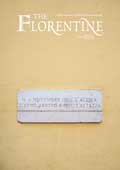
Now take a walk over the Ponte Santa Trinita and see how the Florentine authorities are looking after your interests. At each bridge pier there is a small triangular balcony with a helpful railing that you can use to climb down from bridge to balcony. But beware, you are about to commit a crime. Look closely and you will find a splendid bronze plaque threatening you with a 160 euro fine if you climb over, although I doubt anyone has actually been arrested for this as rules are flexible in Italy. (My friend Lorenzo tells me of an information board he knows that states ‘Regole da rispettare’, while the English translation is simply ‘Rules’. In other countries, rules are rules, while in Italy some are to be respected, others less so.) The Ponte alle Grazie with similar architecture has no discouraging plaque; people use the railing to climb onto the balcony and attach stickers to an anthropomorphic sculpture who is standing there, apparently about to jump into the water.
Jumping in from the Ponte alla Carraia is more difficult as there are no helpful railings whatsoever, but there are many plaques saying Pericolo di Morte (Danger of Death). It is not at all clear what you will die of as the river is pretty shallow there and the water quite clean. The Ponte Vecchio has no railings or plaques, but if you cross the bridge and turn right towards the Uffizi you find a pair of tremendous handrails on both sides of the level walkway. They are the most powerful in the city and have no possible function.
Railings at train stations show the rich variety of Italian design. The handrail at Pisa Centrale has regular metal bobbles rising out of the surface that bruise your hand when you are rushing to catch your train. Old wooden handrails sometimes have similar bobbles to castrate children trying to slide down the banister, presumably with the idea that many mini castrations prevent one big one when they hit the decorative ball at the end. Firenze Santa Maria Novella station has fascist-style rectangular brass rails that must have cost a bit and look earthquake proof. Bologna Centrale, where you usually get lost due to poor signage, beats Florence with double rails at two heights, presumably for adults and children with embossed Braille labels telling the blind which platform they are going to.
Now for my two favourites: the staircase from the ground to the first floor of Palazzo Corsi in via de’ Tornabuoni that hosts the Circolo dell’Unione has an appropriately grand handrail that is being chewed by heraldic lions. Better still is the rail to the offices of The Florentine that begins and ends with an elegant mass of finely worked sharp iron spikes with a vaguely plant-like design. If they don’t slice through your fingers, they will snag on your clothes, so you risk entering the office without your trousers.