Guido di Pietro was born in Rupecanina, a hamlet near Vicchio, in the Mugello, around 1395, where there is a small museum that bears his name and a bronze statue of the artist in his Dominican habit, looking upward while clutching a palette, square and brushes to his chest. Little is known about his family: we know that his father, Pietro, was the son of a certain Gino, and that his younger brother, Benedetto, also became a friar. He gained his early artistic training in the Florentine workshops of Gherardo Starnina and Lorenzo Monaco, from whom he learned the art of illuminating manuscripts. Sometime between 1418 and 1421, he took his vows at the Convent of San Domenico in Fiesole and entered the Observant Dominican Order, a strict branch that emphasized asceticism. He was ordained a priest between 1427 and 1429.
After painting large altarpieces for the San Domenico church, which established his reputation and led to commissions, in the early 1430s he began his famous Annunciations, one of which is in the Prado in Madrid, while the other two can be found in Tuscany. What was perhaps the first of the artist’s three large Annunciations is a 170 by 180 centimetre tempera on panel displayed in the former baptistery of the deconsecrated Church of the Gesù, now the Diocesan Museum, in Cortona. In 1432, a document states that Fra Angelico was working on an Annunciation for the Church of Sant’Alessandro in Brescia, of which no traces remain. Given that only a few years later, the same church commissioned another Annunciation altarpiece—this time from the Venetian artist Jacopo Bellini—it has been suggested that the work Fra Angelico was producing never actually reached Brescia and, for unknown reasons, took a different route. Some scholars have proposed that the work originally intended for Brescia is in fact the Annunciation of Cortona, which came from the Church of San Domenico and was later moved to the Church of the Gesù. It was likely painted during those same years, certainly no later than 1433–34. Fra Angelico also left another important work in Cortona: the Triptych, as the friars from his convent had previously been hosted in Cortona and later in Foligno during a period of exile that ended in 1419. The original predella has also been preserved and is largely believed to be the work of Angelico himself.
Meanwhile, visitors to San Giovanni Valdarno can marvel at the Dominican friar’s Annunciation in the Museum of the Basilica of Santa Maria delle Grazie. Painted between 1432 and 1435, it arrived here from the Convent of San Francesco in nearby Montecarlo, although it was probably executed for another location. In 1944, it was nearly stolen by the Nazis on the orders of the high-ranking official Hermann Göring, who wanted it for his personal collection. However, it was successfully hidden the day before the Germans arrived thanks to a tip-off from art historian and secret agent Rodolfo Siviero. The scene unfolds in a Renaissance-style loggia and, compared to other paintings of the same subject from that era, here the Virgin Mary is shown as fearless, open and welcoming. Notable details include the garden behind the arches on the left, symbolizing Mary’s purity, and the hill in the background with the expulsion of Adam and Eve from the Garden of Eden. In addition to these biblical episodes, five key scenes from the life of Mary are depicted in the lower panels.


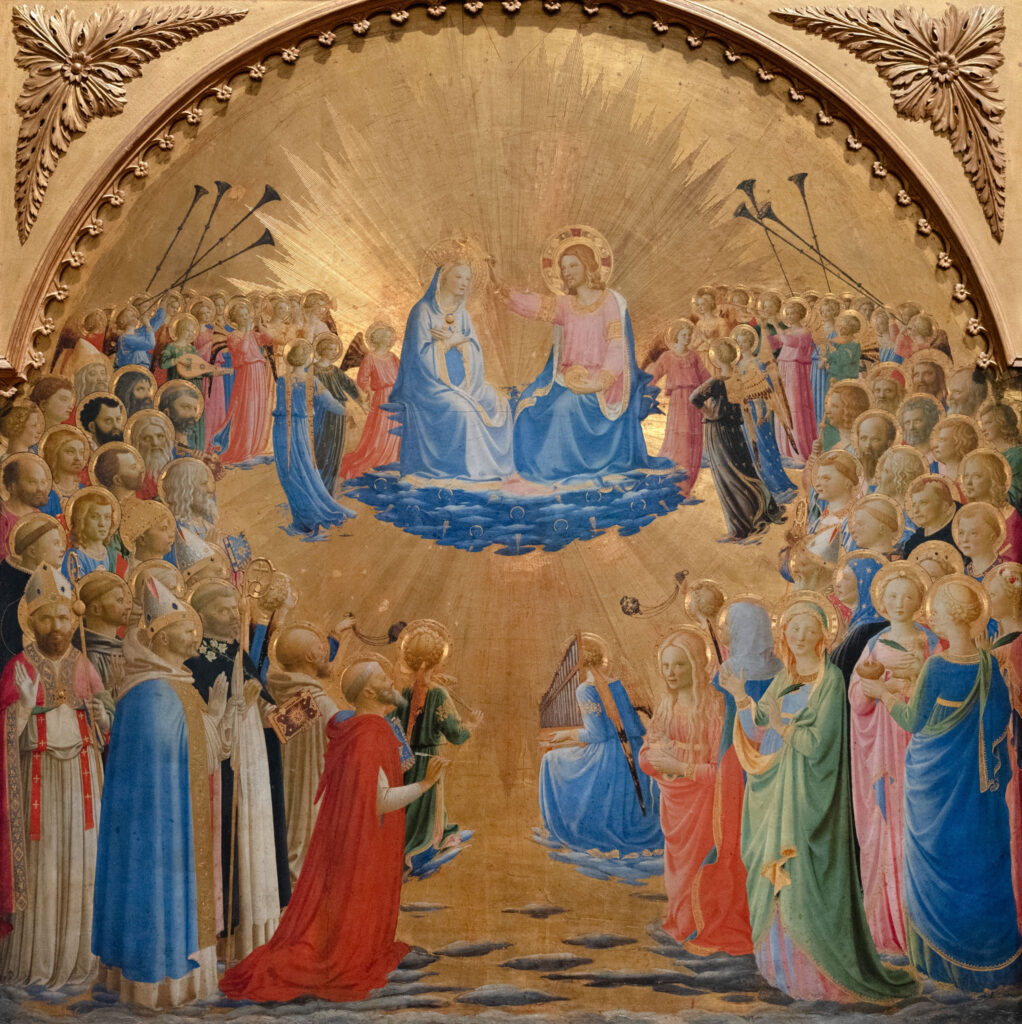
Between 1431 and 1433, he painted the Deposition from the Cross, which recently underwent a two-year restoration campaign and is now on display in the Museum of San Marco, although it is expected to be moved to Palazzo Strozzi for the upcoming Beato Angelico show. Another recent restoration project saw Fra Angelico’s Crucifixion fresco, marked by the unusual downward tilt of Christ’s head, in the chapter house of the Convent of San Domenico in Fiesole return to public view in June. Both of these projects were made possible thanks to the endeavours of Friends of Florence, a U.S. non-profit organization. Also on show in Florence is the luminous Coronation of the Virgin (c. 1432), which hangs in the Uffizi.
The artist became pivotal to the Medici-backed artistic revival during the Council of Florence and, by 1440, Cosimo de’ Medici had appointed him to lead the pictorial decoration of the newly rebuilt Convent of San Marco. Towards the end of 1445, he was summoned to Rome by Pope Eugene IV, who had lived in Florence and admired the friar’s work. There, he painted the lost Chapel of the Sacrament and the Niccoline Chapel frescoes for Pope Nicholas V. Back in Tuscany by 1450, Angelico became prior of San Domenico in Fiesole, when he likely painted the North Corridor Annunciation and Madonna of the Shadows in San Marco as well as the Silver Chest Panels. His final work was probably the Adoration of the Magi tondo, begun in 1455 and finished by Lippi. He died in Rome on February 18, 1455, shortly before Pope Nicholas V, and was buried in Santa Maria sopra Minerva, receiving the rare honour of a marble tomb.
A founding father of Renaissance art, Beato Angelico sought to unite perspective and human anatomy with the educational role of art and the mystical significance of light.

Fra Angelico will run from September 26 to January 25, 2026, at Palazzo Strozzi and the Museum of San Marco. Co-organized with the regional directorate of national museums of Tuscany of the Ministry of Culture, the show explores the production, development and influence of Beato Angelico’s art in dialogue with painters such as Lorenzo Monaco, Masaccio and Filippo Lippi, as well as sculptors like Lorenzo Ghiberti, Michelozzo and Luca della Robbia. The result of more than four years of work, the project has enabled an operation of exceptional scientific and cultural value, bringing together paintings, drawings, sculptures and illuminated manuscripts from prestigious museums, libraries and collections both in Italy and abroad, as well as from many churches and local institutions of significant historical and cultural importance. Curated by Carl Brandon Strehlke, curator emeritus of the Philadelphia Museum of Art, Fra Angelico is the first major exhibition in Florence dedicated to the artist in 70 years.