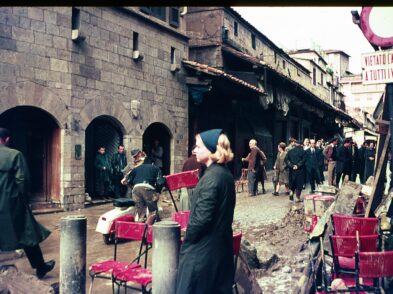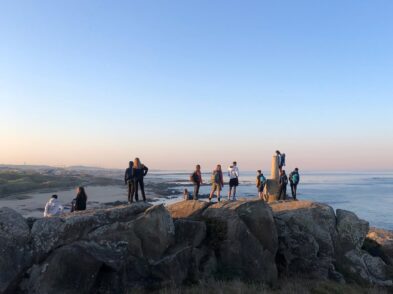
On that dark day of November 4, 1966, 88 Stanford-in-Italy undergraduate students were living and studying at the Villa San Paolo, a property perched on a hill above the city that was owned by the Barnabiti religious order and leased by Stanford for its overseas study program. It was the first time many of those students had been out of the United States—or in some cases, out of California—and the events of that time left indelible memories, which they recollected some 50-plus years later in a memory booklet replete with black-and-white photos.
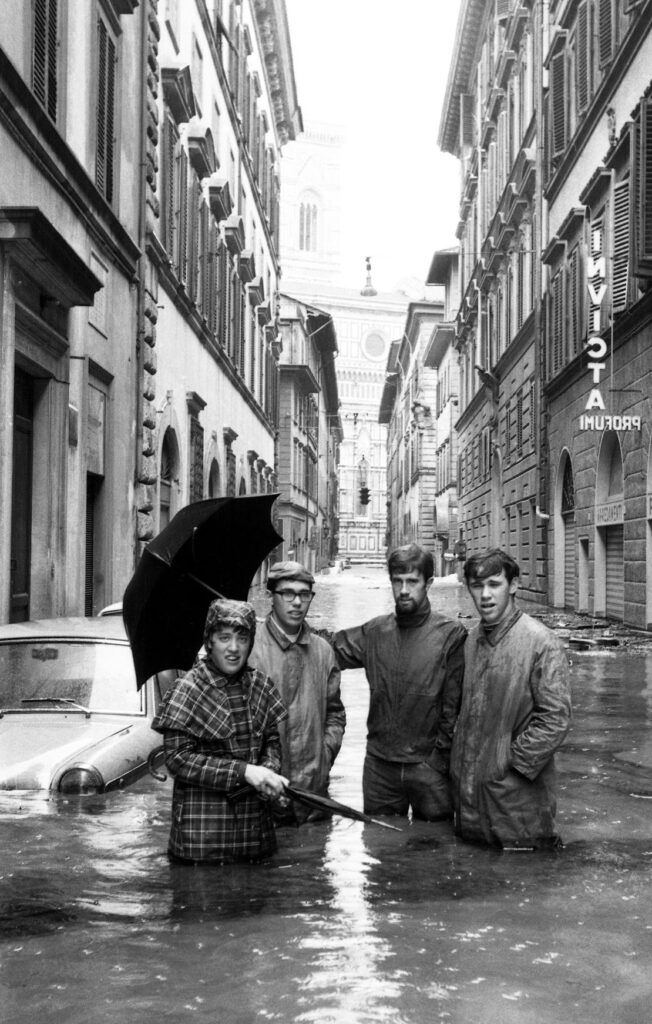
As they remember it, the flood hit overnight, with no advance warning. News of the devastation filtered up to the villa the following morning, and quite a few of these young and curious students headed down toward the city center to assess the damage.
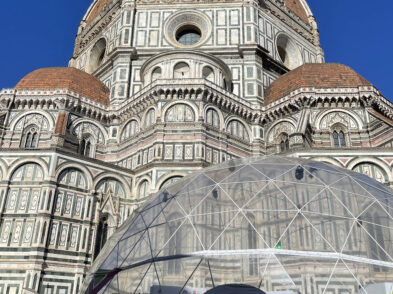
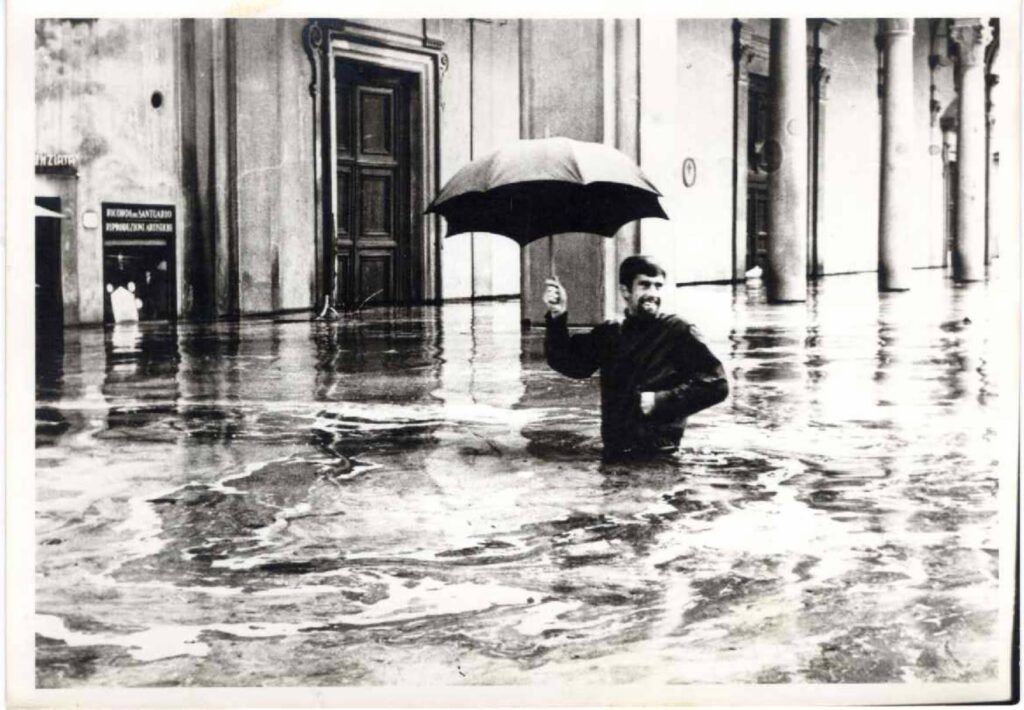
Bobbie Birleffi, a sophomore from Cheyenne, Wyoming, joined three male friends on one of the first forays downtown to check on the height of the floodwaters. She doesn’t remember if she borrowed boots from one of the villa’s staffers or just wore her loafers, but she threw on the Lanz red plaid raincoat her mother had picked out from a fancy store in her hometown (“the coat would never be the same”) and joined the impromptu reconnaissance team heading to the Duomo. When they arrived, the water was already waist-high on some streets, with cars and furniture swirling by. They waded through the streets and fellow student Alan Lamont, who had brought his camera, snapped a few photos of the devastation. Then, linking arms as a precaution, they headed back through the rushing current toward the villa.
Jackie Van Rysselberghe, a junior from Eugene, Oregon, and her roommate also decided to check out the devastation. On the way to the city center, she remembers catching sight of the villa’s elegant director, Dr. Giuseppe Mammarella, dressed in “his customary sleek three-piece suit, designer trench coat, umbrella over his arm, his perfectly pressed pantlegs rolled up to his knees, filthy flood water lapping over his Florentine leather shoes”. He was on his way to the U.S. Consulate to inform Stanford University and the students’ parents that all were okay, away from danger.
At that time, news traveled slowly. It was not common, and very expensive, to make phone calls back and forth between Europe and the United States. And of course, there was no internet or email. Students would write home using onion-skin paper (less weight and postage) or the flimsy, blue aerogrammes that formed a letter and envelope all in one. Sophomore Bob Fries, who had worked as a copy editor for The Stanford Daily newspaper, managed to get three student accounts of the flood to the Daily’s managing editor, who featured them on the front page of the November 11 issue. Sophomore Amy Newell’s parents received a letter describing how the flood waters, slick with two inches of heating oil floating on the surface, seeped through the small shops, famed museums, ancient churches and storied art galleries, decimating many of Florence’s treasured antiquities, including Ghiberti’s Doors of Paradise, where five of its heavy bronze panels went missing. The letter was published in her hometown paper, the Watsonville Register-Pajaronian & Sun on November 22.
None of the students ever thought they would be sent home, though the administration did consider it for a few days. But in the end, it was decided that the students and their professors would ride out whatever came their way.
As assistant to the director, Lauren Dunbar, recalls, “Even though [we] were advised to stay out of the flood zone in centro, many students rushed down to the oil-infused, muddy streets to check on the safety of Florentine friends and various shopkeepers”. Dunbar helped connect students to rescue efforts organized by the British-American Flood Relief program, most notably at the Biblioteca Nazionale where they hauled “musty smelling, soaked books and treasured manuscripts to the upper floors where [we] peeled back each page with tweezers to insert single sheets of Japanese rice paper that would hopefully dry out and preserve each book. Some had doubts. This was bone-chilling work!”
Students also became involved in the effort to save precious artwork from the lower floors of the Uffizi Gallery. One of them, John Carter, can be seen in a photo published in National Geographic’s July 1967 cover story “Florence Rises from the Flood”, carrying a painting high overhead, his shirt displaying the words “Property of Stanford University”. Another student, Randy Elwood, remembers “scooping mud out of the lower level of the Uffizi using makeshift squeegees nailed together from ornate gilded picture frames.”
Through the following days, Stanford students worked alongside young people from all over the city, many from American universities who also had a presence in Florence, such as Gonzaga University, Florida State University and California State University’s international program. The call for assistance spread far and wide, and soon young people from many countries flocked to Florence, some being housed, courtesy of the mayor, in railroad cars at Santa Maria Novella station. The Florentines were so grateful for this influx of help that they dubbed these young volunteers Angeli del Fango, Mud Angels.
Even though the devastation happened 60 years ago, many Stanford alumni still retain vivid memories of the experience. Those whose Italian was moderately good remember going house to house in the hard-hit Oltrarno, checking on families and delivering blankets, medicine and food. Allen Sanford recalls helping to clean up a leather shop near the Ponte Vecchio, a task for which the grateful owner thanked him repeatedly in Christmas cards over many years. Jackie Van Rysselberghe remembers how she and her friends, while taking “a stunned walk along the Arno, cameras in hand”, were hailed by the jewelers on the Ponte Vecchio who shouted at them to put away down their cameras and help dig out, which they did, retrieving gold jewelry and gems from the mud and returning them to the shopkeepers. (During those chaotic days, Van Rysselberghe met an Italian TV cameraman who was filming a documentary about the flood and later married him.)
The main deprivations the students themselves suffered at the villa during those weeks were lack of heat, lack of electricity and a severe shortage of water. Bobbie Birleffi remembers the students were each given “one Chianti bottle of water a day for everything (drinking, washing, etc.).” They would eventually take trips to neighboring cities, Rome and Bologna, to take showers and buy bottled water. Not surprisingly, there was ingenuity, too. In the lower part of the villa’s garden, sophomore Ben Buchanan found a spring that drained into a small pipe at shower height. For several weeks he would take bracing, soap-less, ice-cold showers there.
The dampness from the flood lingered on in the city for months. Bill Russell, a senior at the time, still feels the effect of the disaster. “I do have a deep sadness remembering that flood and the horrifically ugly damage that it brought. I’m sure it has left a deep and silent imprint on the emotions of all of us from this group in ways in which we are not even aware.”
Looking back, Dr. Mammarella, now in his mid-90s, recalls the Mud Angels with deep affection. For him, the photograph of John Carter hoisting a large painting overhead has become a near-mythic emblem of solidarity between the students and Florentines, a shared effort to save works of art that belong to a global cultural inheritance in which everyone has a stake. “Those who came from Stanford in the 1960s and the 1970s,” he said recently, “were the expression of a society that . . . showed a common purpose and vision.” For that, he says, he remains most grateful.
Read the student accounts here.
This article was written by Sharon Olson + Holly Wheeler Brady.
Sharon Olson, former librarian with the City of Palo Alto for many years, is the author of several books of poetry, including Will There Be Music, and has written many articles in the field of genealogy.
Holly Wheeler Brady is the former director of the Stanford Professional Publishing Course and author of the novel Pescadero.
Both were members of Italy XIV, the group that followed the Mud Angels to Florence. They saw little of the devastation that the flood wrought, except for waterlines on all the buildings. In fact, they unwittingly benefitted from the work of their predecessors: whenever they identified themselves as Stanford students to the Florentine shopkeepers, they were offered deep discounts.