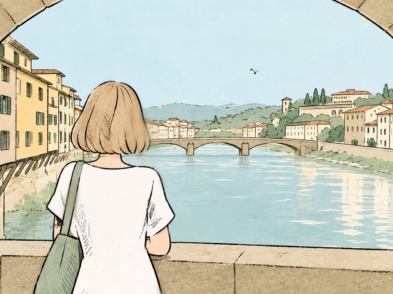
A few weeks ago I stood in the piazza della Signoria with a group of our Grade 5 students, watching one girl try, for a good three minutes, to sketch the Palazzo Vecchio’s tower without once looking down at her page. She got the proportions wrong, rubbed it out, started again. That’s the kind of learning no worksheet can manufacture, and it’s the reason I think our students are quietly some of the luckiest in the world.
Florence was never built to be a museum, though visitors often treat it that way. For our students, it’s a working city that happens to double as the best-resourced classroom imaginable. Our history teachers don’t need a textbook chapter on the Renaissance when the Duomo’s dome is a twenty-minute walk from school and Brunelleschi’s engineering problems are still, in a sense, standing there to be solved. Ask a child to explain how something that heavy stays up without modern steel, and you’ll get a far more honest wrestle with the concept than any diagram provides.
The same goes for science. A visit to the Museo Galileo, where children can see the actual instruments Galileo used to argue with the entire scientific establishment of his day, tends to stick in a way that a chapter on the history of astronomy doesn’t. One of our students told me, quite seriously, that he thought Galileo “seemed annoying to be around, but right” — which is possibly the most accurate seven-word review of the man I’ve heard.
Art, obviously, barely needs an argument here. But it’s worth saying that standing in front of a Botticelli is a different act than seeing it on a screen; students notice brushwork, scale, the slight yellowing of varnish, in ways that shift how they think about their own work back in the art room.
What I’d really like more families to know, though, is that this isn’t limited to famous names. Some of the richest learning happens through our partnerships with local artisans, small workshops in Santo Spirito where a leather worker or bookbinder will explain a technique passed down through four generations. Public spaces matter too — a market square becomes a maths lesson in estimation and negotiation; a city park becomes a biology field site. None of it requires a plane ticket or an entrance fee, just a willingness to treat the city outside our gates as seriously as we treat the one inside them.
This is very much by design. Using Florence as a catalyst for curiosity is one of our clearest priorities this year, and it shows up in the small, unglamorous logistics as much as the big excursions — a shared calendar of local learning links, teachers trading ideas about which piazza works for which lesson.
Our students will leave Florence one day. I’d like them to leave having actually looked at it.
Sharyn Baddeley, Head of School