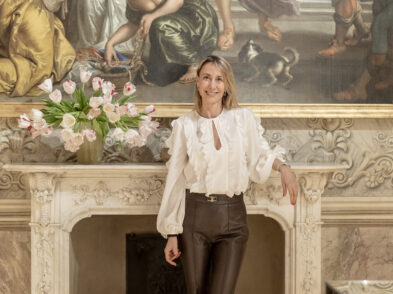
Tommaso Corsini, one of the heirs to the historic Florentine family and CEO of the Corsini Events Group, recently spoke about innovations in the private events industry during a conversation in front of a live audience at The British Institute of Florence.

We met recently at Villa Corsini a Mezzomonte in the hills of Florence. Tell us about its history, what’s involved in maintaining it and how the events business is going there?
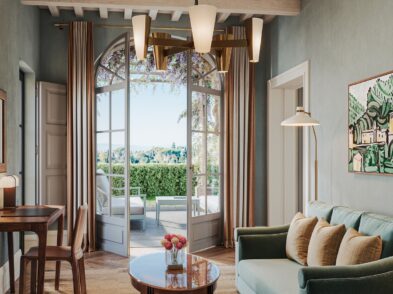
Villa Corsini a Mezzomonte was created by the Buondelmonti family in the late 11th century. It began as a fortified farm and developed over the centuries until it was purchased by Lorenzo the Magnificent in 1480, followed by the Panciatichi family in the 16th century who gave the villa the layout we see today, and then by Giovan Carlo de’ Medici, the youngest brother of Grand Duke Ferdinand II. As a young prince, he didn’t have much to do. He was supposed to marry very well to a princess with the biggest dowry in Europe, but he failed to meet it basically because he didn’t like the idea of getting married. So he became a cardinal instead. He kept the villa and turned it into a place for his three main passions: flowers, arts and parties. He was so passionate about flowers that he got involved in the world’s first financial bubble, losing all his money in tulips and in parties! In 1644, he was obliged to sell the villa and it was acquired by Marquis Andrea Corsini. In 1966, my grandfather was one of the first in Florence to open a private house to the event business, not because of a pioneering vision, but simply because he had to make it work financially. He was working in Mozambique and opened up the estate with third parties managing it up until the mid-Nineties. My father took over the villa in 1995-96 and I took it over in 2010. To make a long story short, I’ve multiplied the business about 76 times. Not by inventing anything new, just rethinking how to work with destination weddings and how to harness the cultural heritage of the villa. It was important to look at the Medici archives to understand how the villa worked and rethink the flow of events based on the way they did it.
It’s a fascinating setup because you walk through room after room. It’s not the sort of place that you could easily sell and turn into a hotel, for example.
First of all, the piano nobile is on the ground floor, which is uncommon in a Renaissance villa. Second, there are only two doors between the entrance and the main hall, which is also strange. The gallery was frescoed in 1631 by Pandolfo Sacchi, when he was 19, who isn’t a well-known name because he died at 22. By looking at the gallery, you can see that he was supposed to become somebody because the central fresco in the same gallery is by Passignano. A minor artist would not have been placed next to somebody like that. Then we have art by Bacio Del Bianco, Angelo Michele Colonna and Giovanni da San Giovanni, all the main fresco makers in the early 17th century, simply because a competition was held at the villa in order to decide who would decorate the new throne room in Florence, the Room of Apollo at Palazzo Pitti.

Corsini Events produces some of the best happenings in Florence. Tell us about some of your most memorable events.
In 2015, I created Corsini Events, an events production company because clients started to ask us to organize events in other venues too. To separate the risk and the businesses, I decided to set up a new company. In 2025 alone, we produced 164 events. We shape event planning services depending on the needs of the client…With destination weddings, people come from all over the world and they all have different needs. Events are more and more that physical place where people need to communicate who they are and who they want to be. It’s exactly the same thing with companies, but you can be much more direct.
The ReGeneration Festival in the Boboli Gardens during the Covid summer must be a lasting memory for you.
It’s one of my best memories ever. In August 2020, we produced the only outdoor opera festival that year in Europe. Four nights, 650 people a night. I still don’t know how we did it. We started organizing the festival in mid-June, unloading something like 2,500 cubic metres of materials. We literally created a village of about 200 people. I’m extremely grateful to the Mascarade Opera Foundation, to Roger Granville, Max Fane and Frankie Parham, who are the masters of ceremony of everything behind the scenes. We were simply the soldiers who made things happen.
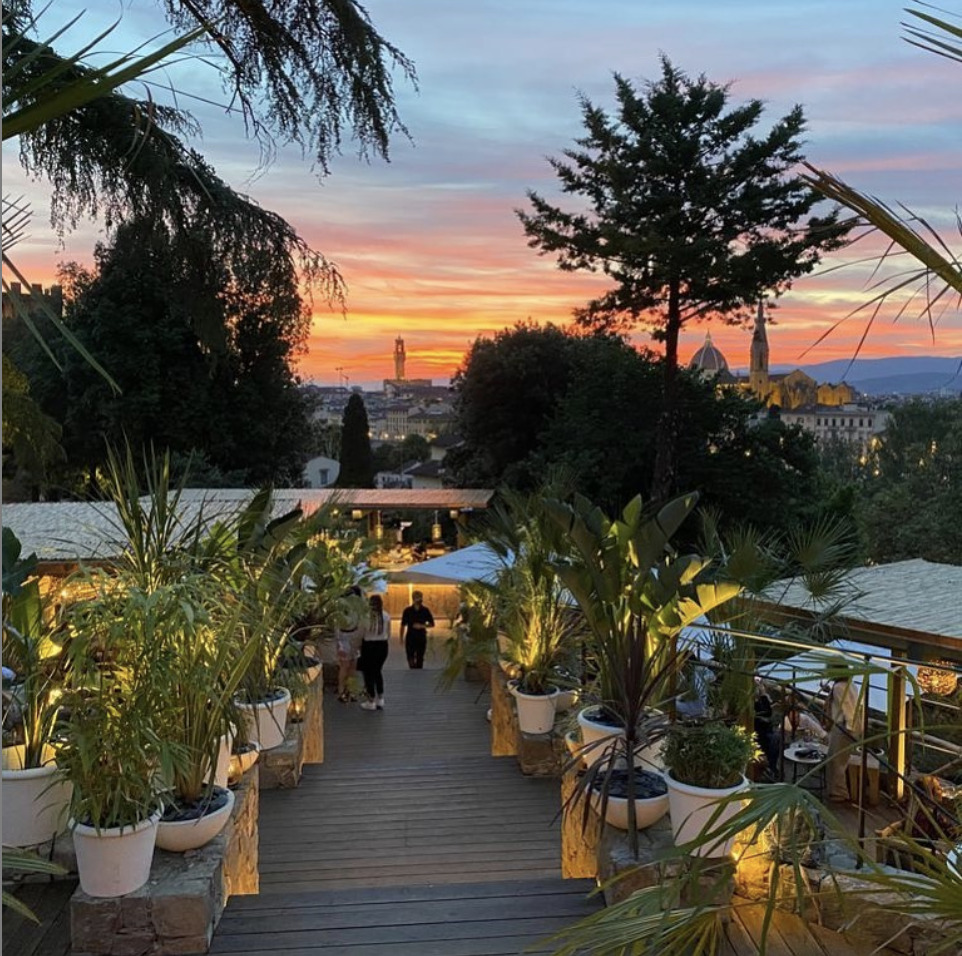
You’re also one of the owners of The Lodge, a former roadman’s lodge turned favourite night spot. How did that project come about?
It was Lorenzo Segre’s idea, a good friend of mine and the owner of Colle Bereto. We started by investing in a place that had been completely ruined after 30 years of neglect. We secured the entire bastion, which was the old carbonaia where wood was turned into coal using roots from San Miniato al Monte and a cart on a ramp delivered the coal down the hill to San Niccolò. After doing all the work, we opened a dinner club, which is very much appreciated by Florentines. It was something that was missing in Florence.
You also organize WIM, a trade event that brings together professionals to discuss the private event industry.
When we first created it in 2018, it was an acronym for Wedding Industry Meeting. Then it became We Inspire Memories because we opened it up to the whole of the private event industry. Now it’s become Where Ideas Meet. The private event industry in Italy consists of about 55,000 companies, including hairdressers, hotels, flower designers, catering and transportation. All completely different businesses that create an ecosystem that makes the event happen. This supply chain has never been identified because the numbers for the catering are registered with restaurants, statistically speaking. We decided to bring all these professionals together to understand the state of the market and come up with statistics about our industry. We started with 100 companies and now we welcome 500 businesses in Florence. It’s become the biggest B2B event for the private event industry in Italy.

You’ve just presented an AI-powered professional platform to help SMEs in the private events industry. How did that idea come about and how has the idea been received?
After last year’s WIM, we went on a tour of 13 events, nine in Italy and four abroad, meeting 800 companies who are all doing different jobs in our industry, trying to find out what they needed. Then we turned those responses into something tangible, which is the WIMforPRO platform we launched at WIM 2025. It’s the first ever B2B digital platform based on agentic AI. For example, Photoshop has agentic AI, which suggests the best way to edit your photos. Our agentic AI is like ChatGPT, Gemini or Llama. You can ask it anything you want related to the private event industry, such as a planner looking for a historic venue for 200 people where the guests can bring a Michelin-star chef. It’s a new system of searching companies.
What’s the state of the private events industry in Italy?
The private event industry in Italy has a direct value of about 20 billion euro and a turnover of about 40 billion euro. Plus, we’ve calculated the social, cultural and financial impact. A society that celebrates looks to the future, so socially speaking, the event industry is a super optimistic one. In terms of culture, the event industry needs places and places in Italy mean historical venues. The rent that you pay to the venue helps the venue to be restored, which helps to bring more events to the area. It’s a positive loop that helps the owners of historical properties to stay where they are without being forced to sell. Unfortunately, most of the time international groups treat Florence like a cash cow and show no interest in investing in local communities. That’s why we want to create a system that helps local owners to maintain the cultural heritage. When it comes to the financial side, the supply chain is 100 percent not only Italian but local. When you do an event in Puglia, what you spend in Puglia stays in Puglia. Seventy-five per cent of our supply chain are micro companies, 20% small and medium companies and only 5% are big companies. This means when you spend 100,000 euro on an event, you are actually putting together 14 to 20 different vendors who each get a small piece of the cake, but that slice gives that company life. That’s truly unique to our industry.
How do you interpret the responsibility and destiny of being a Corsini heir?
When my father gave me our family ring, there was a note that read: Wear this symbol of seven centuries of labour with honour. He also told me something that I keep in my heart: “Always remember that a true gentleman is equal to everybody and superior to no-one.” His words made me realize that it’s fundamental to know the family story, the cultural heritage of our cities and countryside, and our homes. But most of all, it’s essential to have a profound attachment to certain principles and the knowledge that certain values only stay alive if you work on them every day.