The Merriam-Webster Dictionary defines a natural disaster as “a sudden and terrible event in nature (such as a hurricane, tornado, or flood) that usually results in serious damage and many deaths”. After three days of incessant rain, the flood struck Florence and the surrounding hinterland, as well as Pisa, on November 4, 1966. At the same time, Venice was also flooded. This was not only a disaster, it was a catastrophe. Nothing like it had been seen in Florence since the 1333 inundation. It caused the deaths of 35 people, many of whom drowned tragically before help could reach them, and 50,000 families were left homeless. It provoked a food shortage and a health risk, while 15,000 wrecked cars littered the streets and 6,000 shops went out of business. Furthermore, the damage to the Florentine artistic, architectural and literary patrimony was inestimable. According to an estimate by UNESCO, the raging water had dumped an estimated 600,000 tons of mud, fuel oil, sewage and rubble on the city.
So, what happened to those places “on the frontline”, like the Società Canottieri Firenze, the historic rowing club, situated on the banks of the Arno river along lungarno Anna Maria Luisa de’ Medici, beneath the Uffizi and a neighbour of Ponte Vecchio? Given that it skirted the banks of the river and was well below street level, the water engulfed it completely. Yet it was able to rise like the mythical phoenix from the ashes thanks to the courage and determination of its then 350 members, who ensured it would not succumb to the calamity and disappear forever. After interviewing the current president of the Canottieri, Sig. Michele Nannelli and a long-time member, Sig. Carlo, known for having an historic memory of the triumphs and tribulations of the Canottieri over the years, a picture emerged of what happened there that night when the flood reached its peak.

In Sig. Carlo’s view, the consequences of the flood would have been far worse if it had not been late at night between November 3 and 4 when the river burst its banks. This meant that fewer people were out and about. Also, November 4 was a national holiday, celebrating the anniversary of the victory of Italy’s armed forces in World War 1, therefore not a working or school day.
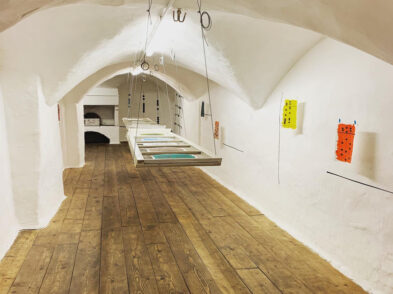
At the Canottieri, the force of more than 60 kilometre-an-hour deluge penetrated the watertight door facing the river and shattered the windows running along the top of the parapets of the medieval walls, which provided daylight to the 100-metre-long corridor, once the stables of the Medici guards’ horses. Now, as it was in 1966, this is where the sculls are housed on multi-decked, parallel supports. The interior was submerged for over 24 hours and everything was destroyed, except for the external walls. The members rallied immediately and, within 30 days, the clubhouse was reborn again, freed of mud and sludge thanks to their efforts assisted by the Ariete Bersaglieri Company of the Italian army, and supported by CONI, the Italian National Olympic Committee. Several club members also assumed the financial burden of the clubhouse and its reconstruction and refurbishment, personally signing the promissory notes required to pay off the bank loans needed to carry out the works, a commitment that took them 15 years to pay back. Only two months after its recovery from the flood, the Canottieri observed its January 1 outing of boats rowing on the Arno, as it had done every year since 1911.
The first Florentine rowing club founded in 1886 was called “Firenze”, which was housed in a wooden construction with a corrugated iron roof along the lungarno Guicciardini near Ponte Santa Trinita. It began organizing regattas a year later. This was followed in 1890 by the Libertas club. In 1911, by inheriting the legacy of these earlier clubs, the Società Canottieri Firenze was established, adopting the colours of Florence’s coat of arms for its white club vests with three alternate red stripes. By May 1933, the club had moved to its present location near the Uffizi. However, other major historic events would encroach upon the Canottieri over the years. These included the two world wars, which are commemorated in the clubhouse with two honour boards listing the names of the club members, who lost their lives fighting for their country.
Another major event could have eradicated the Canottieri. This was when the occupying German army blew up five of the then six bridges crossing the Arno, namely Ponte Santa Trinita, Ponte delle Grazie, Ponte della Vittoria, Ponte della Carraia and the Ponte di Ferro on the night of August 3, 1944. Had the original order, which also included the destruction of Ponte Vecchio, been carried out, the Canottieri would have had little hope of survival.
More recently, another explosion seriously endangered the clubhouse when a car bomb planted by the Sicilian Mafia, the Cosa Nostra, exploded nearby on May 27, 1993. It was intended to damage the Uffizi and was part of a terror campaign against anti-mafia reforms. It killed five people and injured another 60, and caused one million dollars in structural damage to the Uffizi and the nearby Vasari Corridor.
Today, Florence’s over 700-member rowing club continues to grow, participating in national and international regattas, offers rowing courses, and providing welcoming and convivial surroundings for its members to enjoy.