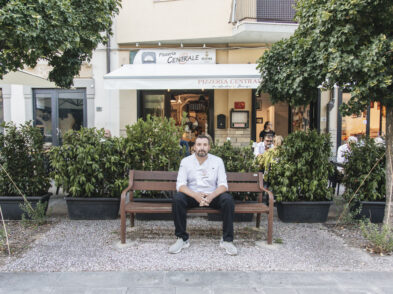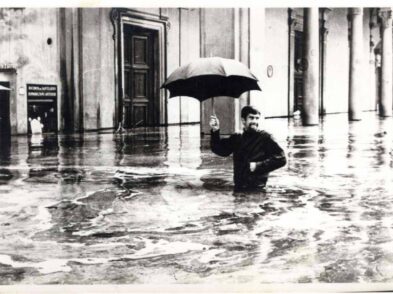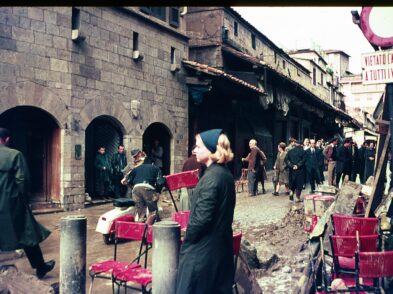
In his Duomo-view dining room at Palazzo Pucci, Giannozzo Pucci shares his memories of the 1966 Florence flood. Aged 22 at the time, he helped coordinate the local Scout movement’s relief efforts before leading the international volunteers who arrived to help with the clean-up.
Can you tell me about your personal experience of the flood?
Well, I wasn’t here then. I was in Pavia, finishing university. That day, I was invited to lunch at a friend’s house in Milan, where I heard that Florence had flooded. I couldn’t leave immediately because I had an appointment at the university secretary’s office the following day to complete the paperwork for my move to Berkeley, in America, after the student movement had started. I did the paperwork and left for Florence that afternoon. When I arrived in Bologna, I thought I wouldn’t be able to get through. But there was a train, one of those that ran on a petrol engine rather than electricity. I arrived in Florence, and the only light at the station was coming from my train.
I had bought some chocolate and a pair of rubber boots. When I came out of the station, the water had gone, but the ground was covered in mud. I came here to the palazzo, where my grandmother was still alive. She died about 11 years later. Everybody who lived in her house was gathered around, so I gave them all the chocolate. This was Saturday; the flood had happened on Friday.
Early the next morning, I cycled out of Florence to see if I could find some bread in the countryside. When I returned, I went to the fire station, where many people were asking for pumps to remove the water. I went with two mechanics who rented a space in the garage downstairs. We saw all these pumps lying around and I asked the firemen about them. They said they were old and didn’t work. So I told the mechanics, “See if you can make them work.” They managed to get two or three running, which made the firemen happy. I said, “But now you have to send them to our place.” The next morning, they arrived with their jeep and did everything they could to remove the water from the garage.
When my father returned from Switzerland the following day, the garage was dry. But my father was rather monopolistic about the palazzo, so I decided to leave because I had already done quite a lot. Instead, I went to the Scouts’ headquarters, which had been set up during the flood. They soon needed someone to coordinate the effort, so I took on that role. There were many volunteers arriving and they needed directions: where to go, what to do and so on. There was a young boy who knew the city well, so he went around taking volunteers wherever they were needed. The volunteers were a mixture of Italians and people from abroad. That was how the whole thing started rolling.
After about a month, at the beginning of December, the Scouts decided to stop. The municipality wanted to take over because so many people wanted to come and help. I was ready to work with the Comune di Firenze. They had rented some rooms in via Ghibellina, near Palazzo Guicciardini, for their operations. They were planning to move the department that had been using the space, so the rooms became available. That was where we established a centre for all the volunteers, with somewhere to sleep as well. I think the Comune rented the rooms from the Guicciardini family. I developed the centre there and we continued working for more than another month, with many people arriving from abroad and elsewhere. We stopped in January. That is mainly what I remember about the work I did, although there are many smaller stories within this bigger story.
You were recognized for your efforts during the flood and went to Monaco, where Princess Grace presented you with an acknowledgement.
I wasn’t awarded in that sense. Princess Grace wanted to do something for the people affected by the flood, but I wasn’t exactly one of the people affected by it in the way she had in mind. The Comune said, “You go, along with another girl from Florence.” We weren’t quite what they had expected, but anyhow.
You were 22 at the time of the flood. How much do you think the flood influenced the life you led afterwards, particularly your commitment to the environment and the common good, as reflected in the title of your book?
It influenced me enormously because I experienced the happiness of working for nothing, towards something you believe in, something necessary, without being paid for it. That has somehow influenced my whole life since then: always giving something back, working for a cause and doing something good for other people.
What was the mood like in those first early days?
There was a sense of community. And not only that. When we went out to work, all the young people who had been working together would come back in the evening happy, singing, you know.
Did you realize at the time that you were doing something important?
I didn’t know how important it was, but it was a happiness to do it. We felt happy doing it. My wife, Lucia, still remembers a song we used to sing in the evenings.
[Giannozzo calls his wife, who sings “John Brown” over the phone.]
Can you recall a couple of particular moments from the relief efforts?
There were some strange things that happened. For instance, one boy who was working for us disappeared at a certain point. Then he came back with his father, quite a simple man who was dressed in a tuxedo. Another was our stock clerk, a German man who had been sleeping on the streets before the flood. Since we had somewhere for him to stay, he was appointed magazziniere, or storekeeper. He took care of all our tools and equipment. He stayed with us until the end, and even after the end. Then there were the people who came from abroad. I can’t remember all their stories very well, but some were extremely motivated and worked really well. They even ended up leading the Italians. On that occasion, I discovered something quite important: people you might expect to come and work for the common good sometimes wouldn’t turn up, while others you might have thought wouldn’t come were completely focused on the work.
How did the Comune handle the situation?
Mayor Piero Bargellini did a good job under difficult circumstances and the people held him in very high regard. His party obliged him to become a senator as soon as election day arrived, so he had to leave. I didn’t want him to go, but he had to, and things changed afterwards. In my case, we collaborated well with the Comune. They sent us the volunteers, we put them to work and they provided the tools. There was also a place where volunteers could go for lunch and dinner, in a mansion in piazza della Libertà. It wasn’t nearby, but it was easy to get there.
How long did it take for Florence to start looking like Florence again?
Our work stopped in January, but Florence never returned to what it had been before. The city’s culture and way of life had been built around its artisans and their communities. I published a book, Diario di un Apprendista Artigiano, which tells the story of what it meant to become an artisan through apprenticeship. It is based on the diary of a boy who had been forced to leave school when the war began, in 1942–43. His mother told him, “Write a diary, so you don’t lose what you’ve learned in reading, writing and so on.” He did so. He became an apprentice to an artisan in via dei Serragli. At first, he carried pieces to other artisans and brought things back. They gave him a nickname and he quickly became part of the community. Little by little, he began to learn and his master would correct him.
With the flood, that community came to an end. Some artisans had lost their workshops. Rents went up, and they left the city centre. In a way, Florence lost some of its quality and identity because of this. Many shop windows were clean again after a month, but the brightness was different from before. It was more appearance than reality. Shops were selling things made elsewhere, industrial products rather than things made locally. There was a shift from craftsmanship to commerce.
So, in your view, the decline of Florence’s identity began after the flood?
Yes, I could say so. Especially because people who owned buildings in the centre began renting them out and the city centre was no longer home to Florentines as it had been before. Now you can only find Florentines at the supermarket or in the hospital. You don’t see them walking around the centre anymore.
As a Florentine, don’t you find that sad?
Of course. But you can’t do much about it. When I think about what this street was like when I was 10 or 12, it was entirely inhabited by Florentines. There was a bakery right in front of the palazzo and a quality dressmaking shop on the corner. People came all the way from Bologna just to buy things there. There was also an antiques shop. Things change when people are motivated by money rather than other goals, values or ideals.
With thanks to Idanna Pucci and Terence Ward for facilitating this interview.